
By George Omagbemi Sylvester
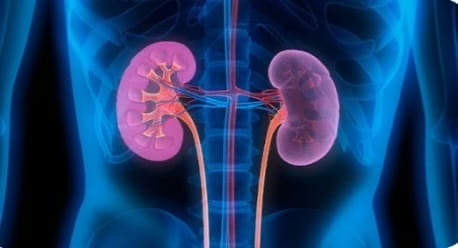
Nigeria is facing a growing public health emergency as kidney disease quietly spreads across the population, with medical experts warning that at least one in every ten Nigerians is affected. The alarming statistic has been echoed by several nephrologists and health authorities, who say the country is drifting towards a full-blown renal crisis driven by lifestyle diseases, poor awareness, and the high cost of treatment.
Consultant nephrologist Dr. Chimezie Okwuonu disclosed that about 20 million Nigerians—roughly 10 percent of the population—are living with kidney-related diseases, stressing that the burden is far higher than many citizens realise.
Similarly, renal care executive Mr. Zahi El-Khatib noted that one in ten Nigerians suffers from kidney disease, with approximately 20,000 new cases of end-stage kidney disease recorded annually.
More recent estimates from Professor Oghenekaro Egbi, a professor of internal medicine and nephrology at Niger Delta University, suggest the figure may be even higher. He disclosed in a 2025 lecture that up to 25 million Nigerians are living with kidney disease, with about 230,000 already requiring dialysis or a transplant.
These figures align with academic reviews indicating that chronic kidney disease (CKD) prevalence in Nigeria generally ranges between 10 and 19 percent among adults, confirming the scale of the problem.
The rise in kidney disease is a nationwide issue, affecting both urban and rural communities. Screening programmes conducted across Nigeria’s six geopolitical zones in 2022 found an overall kidney dysfunction prevalence of 13.7 percent among adults.
Medical researchers involved in the exercise identified hypertension, diabetes, obesity, and proteinuria as the leading risk factors.
Health experts say the surge is largely driven by the rapid increase in non-communicable diseases. Professor Egbi warned that Nigeria is facing a “double burden” of infectious diseases and lifestyle-related conditions such as hypertension and diabetes, both of which are major causes of kidney failure.
He added that poverty, poor diet, and environmental hazards also play a significant role. According to him, widespread consumption of highly processed foods, rising obesity rates, and exposure to industrial pollution—especially in gas-flaring communities—are accelerating kidney damage.
Medical data support this warning. In the national screening programme, nearly 47 percent of participants had hypertension, while over 24 percent were obese, both key drivers of kidney disease.
Former Nigerian President Olusegun Obasanjo also raised an alarm in 2024, stating that about 15 percent of adult Nigerians suffer from irreversible kidney failure, a development he described as life-threatening if left untreated.
He urged lawmakers to strengthen legal and institutional frameworks to support kidney patients and regulate organ transplantation.
How the Problem Unfolds
Kidney disease is often described as a “silent killer” because symptoms may not appear until the organ is severely damaged. Experts say many Nigerians only discover their condition in advanced stages when dialysis or a transplant becomes the only option.
However, treatment is largely unaffordable. Professor Egbi revealed that the majority of patients cannot sustain dialysis due to cost, with many dropping out after only a few sessions.
Nigeria’s health financing structure, where most citizens pay out of pocket, means life-saving procedures remain beyond the reach of millions.
Dr. Okwuonu warned that without aggressive prevention strategies, the number of kidney patients will continue to rise, placing enormous strain on families and the healthcare system.
The Broader Implication
Public health scholars warn that chronic kidney disease is on track to become one of the world’s leading causes of death within the next two decades.
For Nigeria, where screening is limited and treatment costs are prohibitive, the consequences could be severe unless urgent interventions are made.
As Professor Egbi bluntly put it, the kidneys have become “casualties of societal maladies,” a reflection of economic hardship, poor nutrition, and a fragile healthcare system.
Without sustained investment in preventive care, routine screening, and affordable treatment, the silent epidemic may soon become one of Nigeria’s most visible public health tragedies.





Leave a Reply