
By George Omagbemi Sylvester
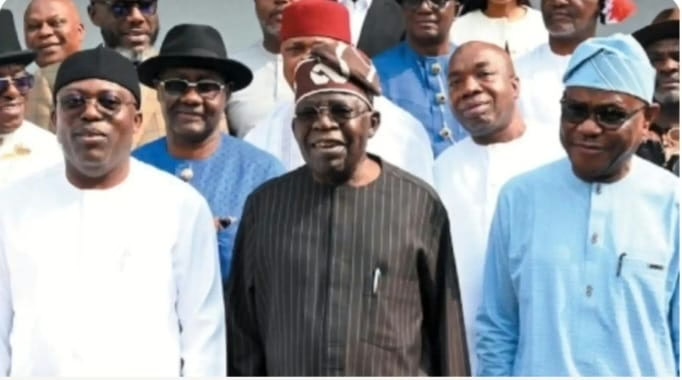
In a critical and commanding exercise of presidential authority, President Bola Ahmed Tinubu has once again intervened decisively in the deepening political crisis engulfing Rivers State, issuing a clear directive to halt the impeachment plot against Governor Siminalayi Fubara and demanding a recalibration of political relations in one of Nigeria’s most politically consequential states. The president’s action is neither symbolic nor tentative; it is a firm declaration that political instability and internecine rivalry, especially when they threaten governance and democratic processes, will not be tolerated under his leadership.
The Rivers State crisis has morphed into a complex web of political contestation, personal rivalry, institutional gridlock and governance paralysis that has repeatedly tested the resilience of Nigeria’s democratic structures. It pits Governor Fubara, the serving chief executive elected by the people of Rivers State, against his predecessor and now Minister of the Federal Capital Territory (FCT), Nyesom Wike; a political juggernaut whose influence stretches far beyond the state’s borders and into the corridors of national power. The feud, rooted in struggles over party leadership, political authority, and loyalty, has metastasised into repeated threats of impeachment and prolonged institutional dysfunction.
At the heart of the current confrontation were impeachment proceedings initiated by lawmakers aligned with Wike. These efforts, framed as a bid to remove Governor Fubara from office, had escalated tensions and brought the machinery of governance in the oil-rich state to a near standstill. But President Tinubu’s intervention delivered both a halt to these impeachment manoeuvres and a political realignment meant to restore balance and ensure the continuity of democratic processes.
The president’s directive did more than just freeze impeachment activity; it came with explicit conditions designed to inject political order and mutual respect into the fractured relationship. Central to these conditions is the recognition that Wike must be regarded as the undisputed political leader in Rivers State, a status that transcends party lines and underscores the president’s view of Wike’s seniority in the region’s political hierarchy. This demand was rooted in Tinubu’s insistence that political seniority should not be discarded due to personal disagreements or ambitions. In essence, the president affirmed a hierarchy in which respect for elder statesmanship and experience plays a key role in maintaining political harmony and institutional stability.
In justifying the move, President Tinubu drew a telling parallel with Lagos State’s political landscape, underscoring that personal discord should not negate structural realities of political leadership. As he pointed out, politicians like Babajide Sanwo-Olu and Babatunde Fashola demonstrated that leadership structures work best when respected, even amid transitions. This analogy, drawn from one of Nigeria’s most stable and economically dynamic states, is a subtle yet powerful endorsement of institutional continuity over personal rivalries.
Political scholars have widely framed this intervention as a strategic exercise of executive authority aimed at preserving democratic governance and preventing institutional collapse. According to respected constitutional analyst Professor Akin Osuntokun, “This decisive action underscores a broader constitutional imperative and that governance must not be held hostage by factional interests, and that the executive has both the authority and responsibility to safeguard the democratic enterprise when it is under threat.” Osuntokun goes on to remind observers that “impeachment should not be a weapon for political vendettas, but a constitutional process guided by due cause and institutional integrity.”
However, not all reactions have been supportive. Civil society groups and political actors have decried the utilisation of impeachment as a political weapon, perceiving it as a threat to democratic norms and legislative independence. The Conference of Nigerian Political Parties and the Coalition of National Civil Society Organisations went further, characterising the impeachment threats as a form of weaponisation of legislative power that undermines federalism and democratic governance. According to Baba Abubakar El-Nafaty, “What we are witnessing is not constitutional rectitude, but rather a calculated bid for control that subverts the will of the people.” Such voices stress that without judicial or procedural grounding, impeachment risks becoming a tool for political control rather than accountability.
President Tinubu’s latest intervention is not the first time he has attempted to calm the impasse in Rivers State. In late 2023, he brokered a peace accord that collapsed, leading to the declaration of a six-month state of emergency in the state in March 2025 and the suspension of Governor Fubara. That extraordinary measure highlighted the depths of the political rupture but also raised questions about the balance between executive power and democratic norms. Despite these extraordinary measures, the underlying tensions persisted.
Critics of the president’s handling of the crisis have argued that repeated interventions reflect a pattern where federal authority overshadows local governance autonomy. Yet, Tinubu’s defenders contend that leadership (particularly in moments of political turbulence) demands decisive action that preserves institutional integrity over factional victories. In Tinubu’s own framing, unchecked hostilities and legislative paralysis threaten not just the governance of one state, but the stability and credibility of Nigeria’s democratic project as a whole.
Comparative political theorist Dr. Chidi Nwosu offers an important contextual lens: “When political elites weaponise legislative processes for personal agendas, the result is systemic erosion of democratic norms. Presidential intervention in such cases, when constitutionally grounded, is a corrective mechanism.” Dr. Nwosu’s perspective underscores that national leadership sometimes must act as an arbiter in intra-party or intra-state conflicts that, if left unchecked, could ripple across the entire federation.
Central to the ramifications of Tinubu’s decisions are the party dynamics at play. Wike, though a member of the opposition Peoples Democratic Party (PDP), operates within the federal ruling party’s framework as FCT Minister, a position he has used to bolster his political influence. Governor Fubara, on the other hand, has sought to assert independence and resist control from his predecessor. The intervention, therefore, also speaks to broader questions of party loyalty, cross-party influence and political patronage in Nigeria’s evolving democratic landscape.
The president’s directive also includes provisions for forthcoming Rivers State House of Assembly by-elections, where Tinubu reportedly instructed recognition of candidates loyal to Wike. This element of the peace deal reveals a willingness to intertwine political reconciliation with electoral strategy, a pragmatic nod to the realities of power-sharing and local political influence.
Overall, President Tinubu’s intervention represents a critical moment in Nigeria’s political evolution with one that lays bare the tensions between democratic process and political power, between institutional authority and personal rivalry, and between local autonomy and national leadership. As the dust settles, what remains clear is that peace, while brokered, must be sustained by respect for constitutional norms and genuine commitments to governance. History will judge this intervention not merely in terms of political survival but in how effectively it reorients governance towards stability, accountability and democratic resilience.
In conclusion, Nigeria stands at a crossroads where executive leadership and democratic integrity must find equilibrium. President Tinubu’s bold directive (stopping the impeachment plot and redefining political hierarchy in Rivers) offers a potential pathway to reconciliation. Yet, whether this intervention ushers in lasting peace or simply postpones the underlying conflict will depend on the political actors’ willingness to prioritise governance over factional dominance and democratic norms over personal vendettas.


Leave a Reply