
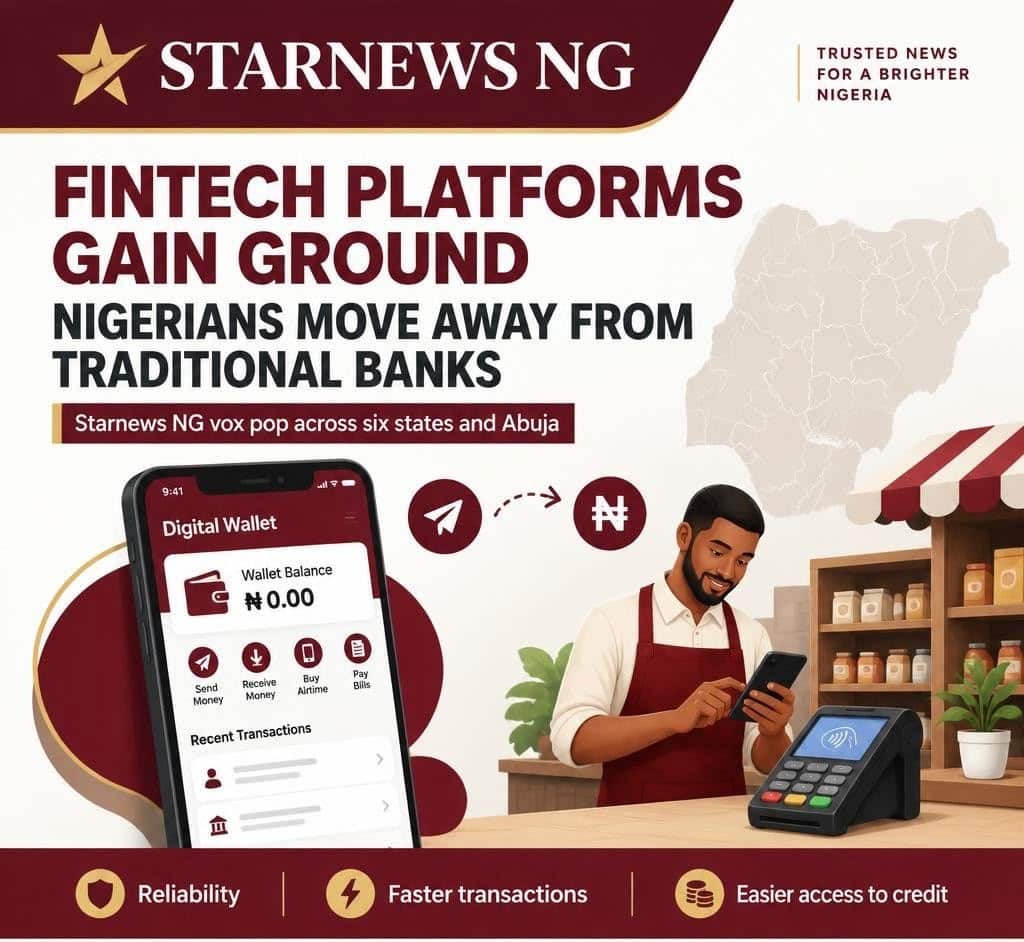

ABUJA, NIGERIA — Fintech platforms are gaining ground in Nigeria as more consumers and small business owners move their deposits and daily transactions away from traditional commercial banks.
A vox pop conducted by Starnews NG across six states representing the country’s six geopolitical zones, as well as the Federal Capital Territory, Abuja, shows that the shift is largely driven by unreliable banking services, delayed transaction reversals and easier access to credit.
Platforms such as OPay, PalmPay, Moniepoint and MoMo have become the preferred financial service providers for the masses, many retail customers and small business owners.
In Lagos and Port Harcourt, traders and professionals complained about frequent network failures, trapped funds and delays in resolving failed transactions. Some respondents said conventional banking applications often become inaccessible during peak periods, while failed transfers could take several days or weeks to resolve.
They said such delays often affected their businesses by tying up working capital.
Others cited poor customer service and lengthy complaint resolution processes as reasons for turning to fintech platforms, which they described as faster and more responsive.
In Kano, Sokoto and Maiduguri, respondents highlighted easier access to credit as a major reason for their preference for fintech services.
They said obtaining loans from traditional banks often required collateral, extensive documentation and lengthy physical verification. By contrast, digital lenders assess customers through their transaction history and other data generated on mobile applications, making it possible for some users to access short-term credit within minutes.
The preference for fintech services was also evident in Lokoja, Kogi State, and Abuja, where consumers, point-of-sale operators, micro-entrepreneurs and commuters cited convenience and lower transaction costs.
Many respondents said fintech platforms had reduced the need for lengthy registration procedures and helped them avoid some account maintenance charges associated with traditional banks.
Starnews NG reports that the trend has also received a boost from recent regulatory developments by the Central Bank of Nigeria, which upgraded the licences of some fintech companies to national status.
The move has strengthened public confidence in digital financial platforms and narrowed the gap between fintech wallets and conventional bank accounts.
As traditional banks continue to contend with ageing infrastructure and rigid service models, Starnews NG reports that fintech companies are steadily expanding their share of the Nigerian financial market and reshaping how millions of people save, transfer and access money.






Leave a Reply