
By Gloria Drealomalicha
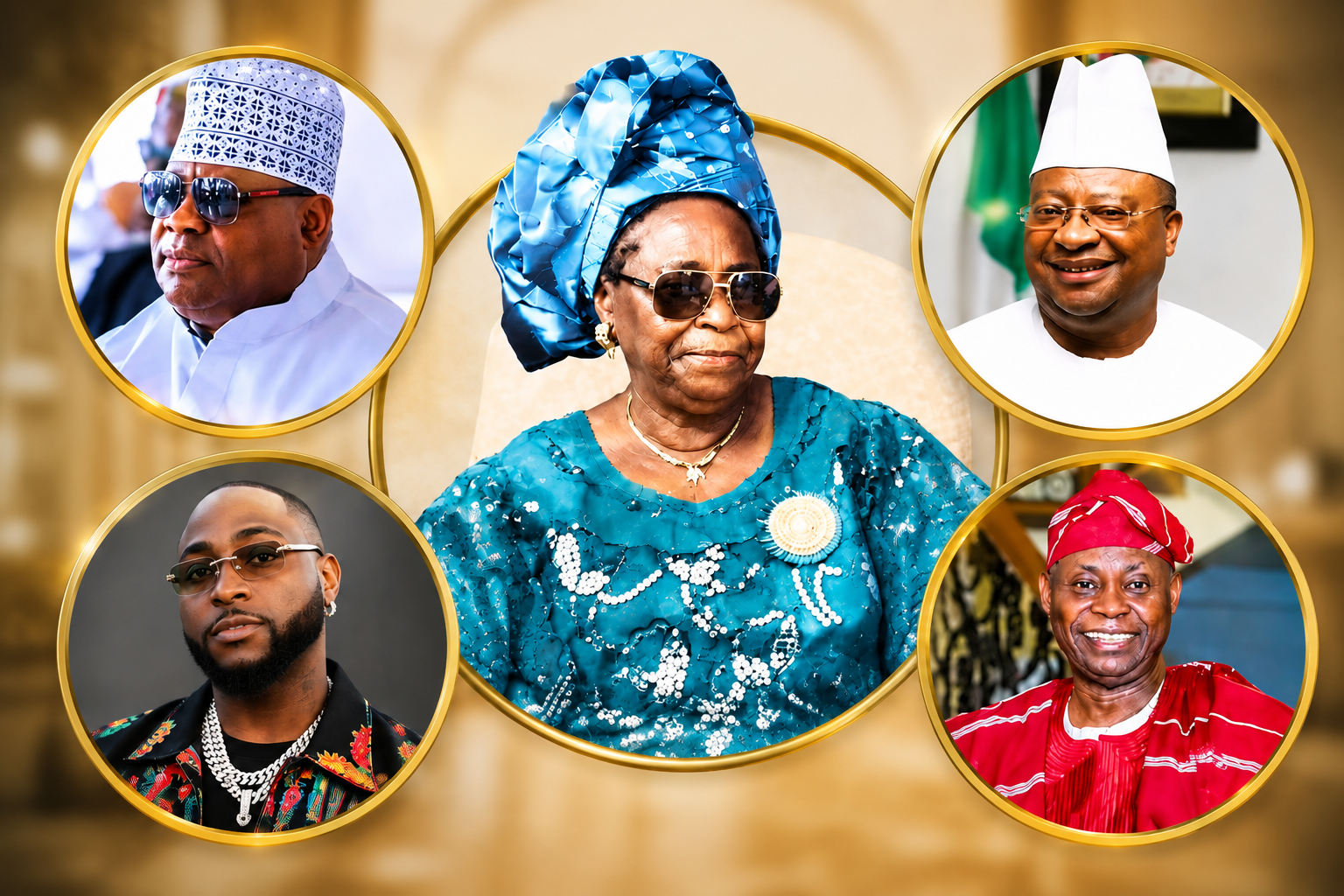
From a woman born in Akwete to two sons who occupied Osun Government House, a billionaire businessman and a grandson who became a global music phenomenon, the Adeleke story is beginning to look less like coincidence and more like a dynasty in the making.
What exactly is happening with the Adeleke family?
That is the question increasingly being asked as the family name stretches from the history books of Osun politics to Nigeria’s boardrooms and the global entertainment industry.
One family.
Two elected governors of the same state.
A billionaire businessman.
A major private university.
A growing footprint in Nigeria’s power sector.
And, perhaps most controversially, one of Africa’s biggest music stars.
At the centre of this extraordinary family story was Nnenna Esther Adeleke, née Akpara, a woman of Igbo heritage from Akwete in present-day Abia State who married into the politically influential Adeleke family of Ede, Osun State.
She could hardly have known that the children she raised would eventually give her family a level of political, economic and cultural influence rarely seen in Nigeria.
Her first son, Isiaka Adetunji Adeleke, made history as Osun State’s first elected civilian governor.
Decades later, her younger son, Ademola Adeleke, would walk into the same Government House.
Another son, Adedeji Adeleke, would build a formidable business empire and establish Adeleke University.
Then came the grandson who changed the equation entirely.
David Adeleke — Davido.
With Davido came something the traditional political establishment could never manufacture easily: global visibility, youth appeal and an enormous social-media audience.
And suddenly, the Adeleke name was no longer confined to Osun politics.
It had become a national brand.
Is this a dynasty?
That is where the debate begins.
Nigeria has seen powerful political families before, but the Adeleke story is unusual because its influence does not depend on politics alone.
The family has political power.
It has considerable business interests.
It has educational institutions.
And it has celebrity influence capable of reaching millions of young Nigerians almost instantly.
Isiaka opened the political door.
Ademola walked through it again.
Adedeji built the economic foundation.
Davido brought the family into popular culture on a global scale.
Put those pieces together and the result is a family with influence across several of the most important arenas of modern Nigerian life.
That is why some observers now describe the Adelekes as a political dynasty.
Others see something more complicated — a family whose wealth, political connections and celebrity influence could give it an unusual advantage over competitors.
And that is where the controversy begins.
The first Adeleke governor.
Before the dancing videos, before Davido’s international concerts and before the social-media battles, there was Isiaka Adeleke.
In 1992, he became the first elected civilian governor of the newly created Osun State.
His tenure lasted barely two years before the military takeover of November 1993 ended the Third Republic.
But the historical significance of that victory never disappeared.
Isiaka had established the Adeleke name in Osun politics.
After his death in 2017, many wondered whether the family’s political chapter had effectively closed.
They were wrong.
Then came Ademola
Ademola Adeleke’s emergence was initially treated by some as a political curiosity.
The dancing.
The flamboyant personality.
The celebrity connections.
The famous nephew.
The critics had plenty to talk about.
But the ballot box told a different story.
In the 2022 governorship election, Adeleke defeated the incumbent Gboyega Oyetola, securing 403,371 votes against Oyetola’s 375,027.
He became governor.
And history repeated itself.
Another Adeleke was now in Osun Government House.
For the first time, two biological brothers had governed the same state at different periods.
That was no longer simply a family story.
It was a political phenomenon.
And then there is Davido
If Ademola’s victory strengthened the family’s political influence, Davido’s fame gave the Adeleke name something even more powerful — reach.
The musician does not need a campaign rally to command attention.
He already has millions of followers.
He does not need to introduce the Adeleke name to young Nigerians.
They know it.
His influence is especially significant because Nigeria’s political future is increasingly being shaped by younger voters and digital platforms.
That makes Davido an unusual political asset.
He can turn a political message into a social-media conversation within minutes.
He can bring entertainment audiences into political discussions.
And he can make an otherwise ordinary campaign appearance become national news.
That is exactly what happened when he became more directly involved in his uncle’s political campaign.
But could Davido become governor?
This is where speculation meets possibility.
There is currently no confirmed declaration by Davido that he intends to contest for governor of Osun State.
But the question refuses to disappear.
And it is not difficult to understand why.
Imagine a future election in which the candidate is not merely Davido the musician, but David Adeleke — grandson of the family matriarch, son of billionaire businessman Adedeji Adeleke, nephew of Governor Ademola Adeleke and grandson of the political legacy established by Isiaka Adeleke.
The campaign would be unlike anything Osun had previously witnessed.
His celebrity following would give him an immediate national platform.
His family’s political structure could provide grassroots connections.
His financial background could support a sophisticated campaign.
And his understanding of youth culture could give him an advantage over traditional politicians.
But there is a catch.
Fame is not governance.
A sold-out concert does not automatically translate into effective public administration.
Millions of followers are not the same as millions of voters.
And a famous surname does not guarantee competence.
If Davido ever enters politics, Nigerians would have to judge him not by his music, his family or his wealth, but by what he can actually offer as a political leader.
That would be the real test.
The billionaire behind the name
Behind the politicians and the pop star stands another powerful figure: Adedeji Adeleke.
The businessman has built interests in several sectors and founded Adeleke University.
His involvement in Nigeria’s power sector has also attracted considerable attention.
Adeleke has publicly said his companies generate about 15 per cent of Nigeria’s electricity, while his investments include a 1,250MW gas-fired power plant estimated at around $2bn.
Those numbers alone illustrate the scale of the economic side of the family.
And they also explain why the Adeleke story cannot be reduced to politics.
The family has money.
It has political connections.
It has institutions.
And it has celebrity.
That combination is extraordinarily powerful.
The uncomfortable question
But there is a question that Nigerians are entitled to ask:
When does a successful family become a dynasty, and when does a dynasty become too powerful?
The answer is not straightforward.
Family members succeeding in politics does not automatically mean anything improper has occurred.
Elections still require votes.
Political opponents still exist.
And voters ultimately determine who occupies elected office.
But in a country where wealth, celebrity, political structures and social influence increasingly intersect, the concentration of these advantages within one family naturally attracts scrutiny.
The Adelekes therefore face a difficult challenge.
Their supporters see a family that has produced successful individuals in politics, business and entertainment.
Their critics may see the emergence of a political machine with extraordinary financial and cultural resources.
Both perspectives will continue to shape the debate around the family.
The legacy of Nnenna Adeleke
Perhaps the most remarkable irony is that the woman at the beginning of this story is not the person most Nigerians remember.
Nnenna Esther Adeleke did not become famous for holding political office.
She did not become a billionaire.
She did not headline concerts around the world.
But her children and grandson carried the family name into all three worlds.
A woman from Akwete married into a Yoruba political family in Ede.
Her son became Osun’s first elected civilian governor.
Another son became governor decades later.
Another built a business and educational empire.
And her grandson became Davido.
That is an extraordinary legacy.
The next chapter
The Adeleke story is far from over.
Ademola’s political future will depend on his performance in office and the voters of Osun.
Adedeji’s business interests will continue to shape the family’s economic footprint.
And Davido’s political involvement may yet become something much bigger.
Perhaps he will remain an internationally celebrated musician who occasionally supports his family’s political ambitions.
Perhaps he will eventually enter politics himself.
Or perhaps another Adeleke will emerge.
Whatever happens, one fact is already difficult to dispute:
The Adelekes have moved beyond being simply a family in Osun politics.
They have become a powerful intersection of politics, money, education and popular culture.
And as Nigeria’s political landscape continues to change, the biggest question may no longer be whether the Adeleke family has influence.
It is how far that influence can go.
For a family that has already produced two governors, a billionaire businessman and Davido, the next chapter could be even more consequential.
The Adeleke dynasty, it seems, is still being written.





Leave a Reply