
By George Omagbemi Sylvester
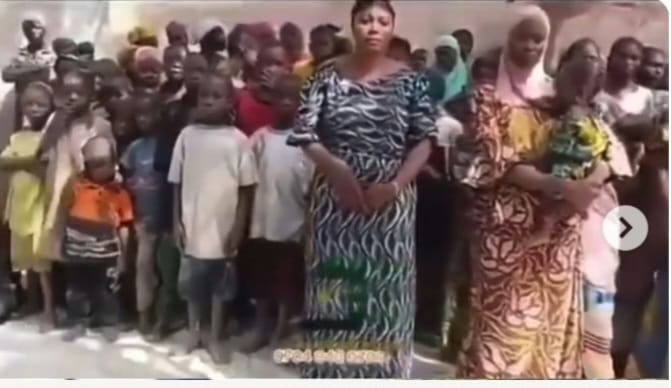
In a grim escalation of Nigeria’s protracted security crisis, suspected Boko Haram terrorists have released a disturbing video showing dozens of abducted women, children, and at least one nursing mother, reportedly held captive following an attack on a rural community in Kwara State.
The footage, obtained and circulated by several credible Nigerian outlets including Starnews NG, depicts captives lined up in a wooded area, visibly distressed and answering questions posed by their captors regarding where they were seized. The militants claim the captives were taken from Woro community in the Kaiama Local Government Area and insist they are holding 176 people, far more than initial official reports acknowledged.
The video, which emerged on 14 February 2026, presents a harrowing scene. Women in worn and dirty clothing stand in rows alongside children; some minors are seen without trousers, underscoring the neglect and harsh conditions of their detention. In the clip, a man believed to be a member of the militant group challenges the Nigerian government, accusing it of “lying” about the scale of the abduction. According to him, officials had initially suggested that only 20–30 people were taken during the February 4 attack—a figure the militants emphatically reject, insisting instead that 176 individuals remain in their custody.
The attack on Woro and neighbouring Nuku villages between 3–4 February 2026 was one of the deadliest episodes in the region’s recent history. Local sources and conflict trackers report that at least 162 residents were killed during the assault, which involved mass shootings, arson, and kidnappings. Homes and the traditional ruler’s palace were burned. Several prominent community figures (including two wives of the Emir of Woro, the community’s Chief Imam, school leaders, and students) were reportedly killed in the onslaught. The Emir himself, Alhaji Saliu Bio Umar, remains missing, raising fears that he may have been abducted or killed.
The group behind the attack identifies itself with Jama’atu Ahlissunnah Lidda’awati wal-Jihad, the formal name of Boko Haram, a terror network that has waged an insurgency against the Nigerian state for over a decade. The assault in Kwara, which is situated in the North-Central region far from the group’s traditional strongholds in the Northeast, reflects the shifting geography of insurgent violence and a trend experts have warned about for years.
Professor John Campbell, a respected scholar on Nigerian security issues and former U.S. Ambassador to Nigeria, has repeatedly underscored the adaptive nature of Boko Haram’s tactics. “When insurgent groups feel pressure in their traditional areas, they disperse into new spaces where governance and security infrastructure are weaker,” Campbell has observed, stressing that evolving insurgent movements exploit ungoverned terrain to sustain violence.
The Kwara State Government, through its spokesperson, has acknowledged the disturbing video and stated it is working with security agencies and community leaders to verify identities and secure the release of those abducted. Officials have emphasised the need for calm and urged the public to avoid rumours, noting that “some persons initially reported missing have since reunited with their families.”
Nonetheless, the dramatic discrepancy between government figures and the claims made in the insurgents’ video has deepened public outrage and heightened distrust in official accounts. Civil society organisations, including the Human Rights Writers Association of Nigeria (HURIWA), have called for a state of emergency in Kwara, arguing that both the federal and state governments must go beyond statements and mount tangible operations to rescue captives and dismantle terror cells. “The primary constitutional duty of government is the protection of lives and property,” HURIWA’s national coordinator, Emmanuel Onwubiko, stated, warning that persistent insecurity and mass abductions raise “serious concerns about governance and accountability.”
For families of the missing and abducted, the absence of clarity, alongside the haunting images from the video, has compounded their anguish. In many Nigerian communities, extremist violence has become a relentless cycle of fear, loss, and displacement. Analysts say that the Kwara incident underscores harsh realities: the porous nature of rural areas, the limitations of current security deployments, and the ease with which extremist factions can spread propaganda and sow confusion.
Dr. Aisha Ahmad, an expert on terrorism and counterinsurgency, recently reflected on the broader implications: “Terrorist narratives thrive where trust in institutions erodes. Governments must not only act decisively on the ground but also communicate transparently, or risk ceding the information battlefield to violent non-state actors.”
As Nigeria grapples with the fallout from the latest assault in Kwara, the world watches a nation at a crossroads where the fight against insurgency is not merely a military endeavour but a test of governance, resilience, and the capacity to protect its most vulnerable citizens.



Leave a Reply