
By Opeyemi Adelakun
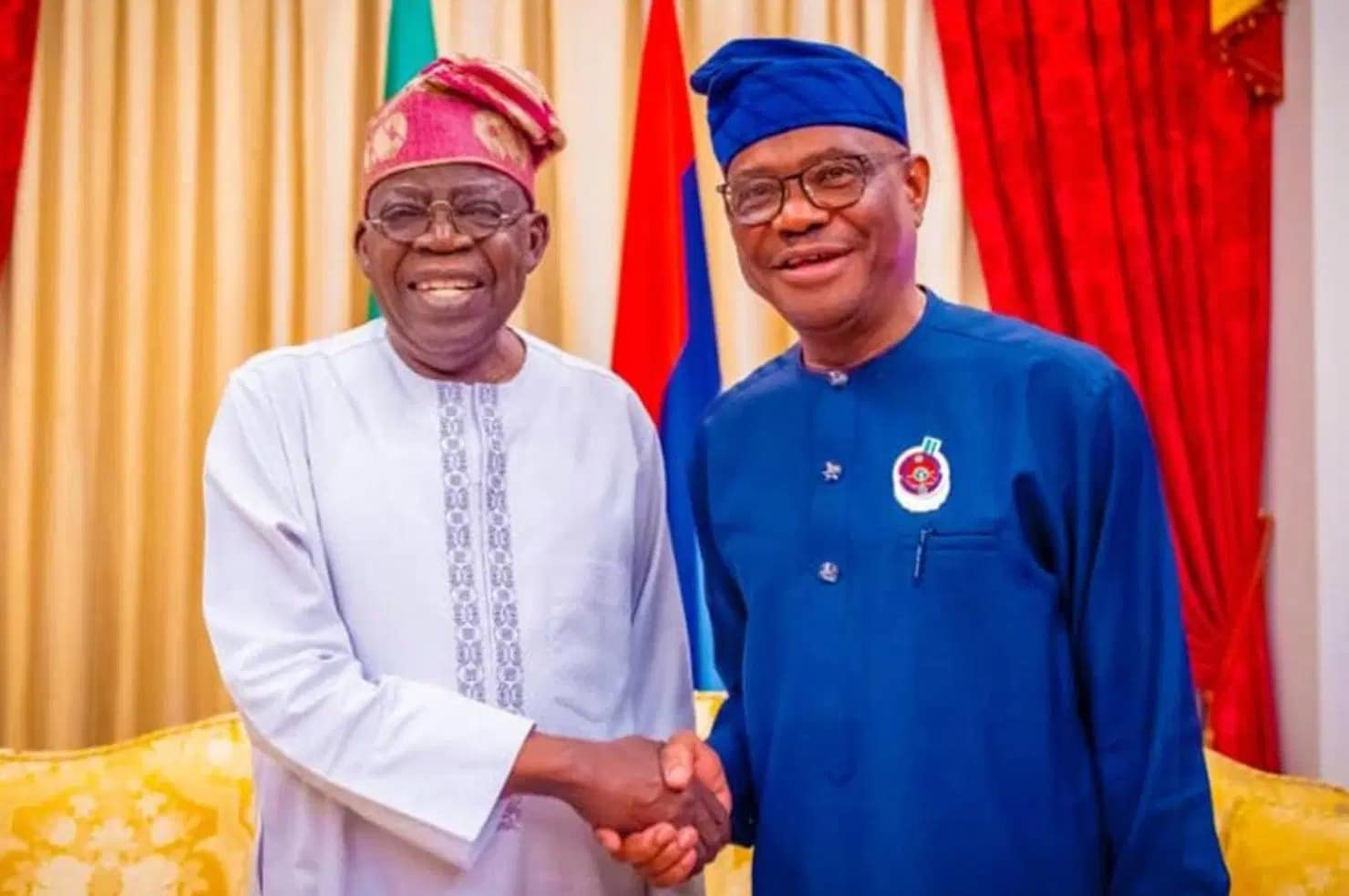
Tensions are rising within the ruling All Progressives Congress, APC, over the political activities of the National Rainbow Coalition associated with Federal Capital Territory Minister, Nyesom Wike, with party blocs warning that the arrangement could undermine the re-election bid of President Bola Tinubu in 2027.
The coalition, which brings together politicians from different parties and political tendencies, has maintained that its central objective is to support Tinubu while allowing its members to pursue candidates of their choice in other electoral contests.
However, some APC governors and party stakeholders are reportedly uncomfortable with the arrangement, arguing that fielding candidates against APC lawmakers and state candidates could create confusion among voters and ultimately affect the President’s performance at the polls.
Wike has repeatedly rejected the suggestion that his political activities are targeted at Tinubu. Speaking during a recent media interaction in Port Harcourt, Rivers State, he maintained that his priority remained the President’s re-election.
He specifically accused Imo State Governor and Chairman of the Progressives Governors Forum, Hope Uzodimma, and Kwara State Governor and Chairman of the Nigeria Governors Forum, AbdulRahman AbdulRazaq, of working against him.
Wike said AbdulRazaq had accused him of backing politicians opposed to the governor’s preferred candidates in Kwara, while he also recalled disagreements with Uzodimma.
Despite the disagreements, the minister said he remained focused on ensuring Tinubu’s return to office.
Sources within the APC governors’ circle said the major concern was the possibility of voters supporting Tinubu for president while backing candidates of other parties in National Assembly and state elections.
The coalition has backed candidates operating on different party platforms, including the PDP, in some constituencies where they are directly challenging APC candidates.
According to the sources, such an arrangement could prove difficult for voters, particularly in rural communities where party identification often influences voting patterns.
They cited previous elections in which voters supported presidential candidates while voting against candidates of the same party at state or National Assembly levels.
The sources also pointed to the 2023 election in Oyo State and the 2003 elections in the South-West as examples of how split-ticket voting could affect down-ballot candidates.
They argued that the emergence of opposition figures such as Atiku Abubakar and Peter Obi could further complicate Tinubu’s calculations if the President fails to secure strong support across key regions.
The concerns have reportedly become particularly pronounced in Rivers, Kwara, Gombe and Cross River.
In Rivers State, the coalition has generated uncertainty over the political configuration ahead of the 2027 governorship election.
The group includes politicians drawn from the APC, PDP, Labour Party and other platforms and emerged from the political struggles that followed the dispute between Wike and Governor Siminalayi Fubara.
Fubara later joined the APC, further altering the political landscape in the state.
Wike’s continued leadership of the coalition has also attracted controversy following the emergence of Ogundu Kingsley Chinda as a governorship candidate associated with the APC arrangement.
Chinda, a former PDP lawmaker, had served as Minority Leader of the House of Representatives before moving towards the APC.
The choice has reportedly generated dissatisfaction among some coalition members from the riverine areas, who believe a candidate from the area should have been considered.
Critics have consequently questioned how Rivers voters are expected to navigate a situation in which politicians from different parties operate under the same coalition while presenting separate party identities.
The political confrontation is also pronounced in Kwara State, where several former or aggrieved APC members have moved towards the PDP and aligned with the Rainbow Coalition.
Among them is Senator Saliu Mustapha, who left the APC after losing political contests within the party and subsequently secured the PDP senatorial ticket for Kwara Central.
Other politicians, including Kolo Jiya, have also moved from the APC to the PDP.
Two members of the Kwara State House of Assembly, Olushola Odetundun and Saba Yisa Gideon, were also reported to have defected.
The coalition formally launched its Kwara chapter under the Otoge Progressives banner in August, presenting itself as a multi-party platform backing Tinubu at the presidential level while allowing members to support other candidates in separate elections.
Political analyst Dr Abdul Kareem Jimoh said APC governors had legitimate reasons to be concerned, arguing that Wike’s growing influence could create consequences for the ruling party beyond the 2027 election.
Lawyer Mohammed, however, said Wike had the right to express his political views, while noting that the prolonged dispute between him and the Kwara governor raised questions about the relationship.
Media practitioner and politician Raheem Adedoyin criticised the use of resources associated with the APC to pursue political interests against the party at the state level.
In Cross River, the coalition is also facing an increasingly complicated political environment, with opposition parties fielding candidates against APC Governor Bassey Otu and other ruling-party candidates.
Reports of defections from the APC to the PDP have further altered the political equation.
In Gombe, former Minister of Communications and Digital Economy, Isa Pantami, has moved to the PDP with the backing of political forces associated with the coalition, creating another example of the alliance’s complex arrangements.
Politics Editor of Arise News, Sunna Sambo, warned that the coalition could ultimately work against Tinubu if voters become uncertain about which party to support across different positions.
He said APC governors were already urging the President to be cautious about the development.
Wike, however, has remained confident in the coalition’s strategy.
Speaking recently, he said Osun State Governor-elect Ademola Adeleke was supporting Tinubu and described the coalition as a vehicle for securing the President’s re-election.
“Adeleke was a member of the PDP, but because of the internal wranglings, and for him to be able to secure a ticket to run for a second term, he had to find a platform,” Wike said.
He added: “so, Adeleke is fully supporting Mr President and so we had to meet last night and encourage ourselves to continue. In the next few weeks, watch what is going to happen. You will see the Rainbow Coalition in this country supporting Mr President.”
Wike also declared that his political objective was to defeat opposition figures ahead of the 2027 elections, saying: “my business is to make them not to feel well. It is not my wish that they should feel well. My business is to make sure that you beat him thoroughly and he will be sick all through. And that is what we are doing to them.”
He further dismissed the notion of a dominant opposition force, saying, “when you say we are leading opposition, I have told you there is no opposition. What do you have? People who are just trying to see whether they can be relevant.”




Leave a Reply