
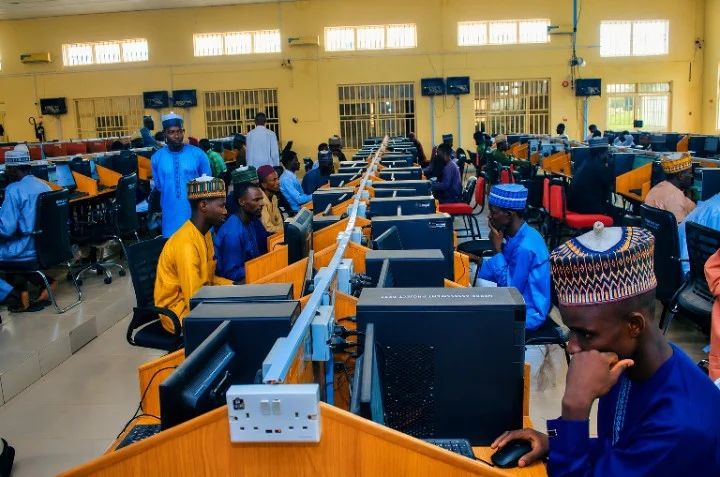
The Jigawa State Government has commenced Computer-Based Tests (CBT) to recruit 500 teachers for its J-Tsangaya programme, drawing over 9,000 graduates and NCE holders for the limited positions.
Abubakar Maje, Executive Secretary of the Jigawa State Tsangaya Education Board, announced this on Sunday after inspecting the exercise in Dutse, Hadejia, and Gumel. He noted that 3,150 applicants were shortlisted for the tests to select the final 500.
This recruitment is central to the state’s Almajiri Free Zone Programme, which aims to enroll over 5,000 Almajirai into a structured system that blends Qur’anic studies with Western education and vocational training. “We want to strengthen the traditional Tsangaya system and reduce the number of children engaged in street begging,” Maje explained.
The initiative includes the establishment of three “mega” Tsangaya schools in Dutse, Kafin Hausa, and Ringim, each designed to accommodate approximately 1,500 pupils. The curriculum will cover English, Mathematics, Basic Science, Computer Studies, and vocational skills, alongside Qur’anic education. The 500 new teachers will be deployed to support these subjects and the integrated curriculum.
Maje highlighted the state’s existing infrastructure, which includes over 5,481 traditional Tsangaya schools, 130 integrated schools, seven modern schools, and the three new mega facilities. He emphasized the government’s commitment to ensuring Tsangaya pupils have opportunities comparable to those available to children across the country.
While candidates praised the transparency of the CBT process, many urged the government to increase the recruitment quota. “With over 9,000 applicants, the government should consider recruiting 1,000 teachers instead of 500,” suggested Musa Ibrahim, a candidate in Dutse. This sentiment was echoed by others, including Aisha Bala in Hadejia, who cited the current economic situation as a reason to expand the slots.
Community leaders have also welcomed the initiative, with some, such as Malam Sani Adamu from Gumel, calling for the expansion of mega schools to more local government areas to reach more children.
The programme represents a broader effort by the Jigawa State government to tackle the challenge of out-of-school children by integrating non-formal schools into a formal, structured educational and welfare system.






Leave a Reply