
By George Omagbemi
The Federal Government has announced a fresh package of measures aimed at easing the pressure of high petrol and transportation costs on Nigerians.
The measures were announced on Thursday by the Minister of Finance and Coordinating Minister of the Economy, Taiwo Oyedele, during a briefing in Abuja on fuel prices and subsidy-related issues.
The package includes a 30-day discount on petrol sold through NNPC Limited outlets, a proposed ₦1,350-per-litre ceiling on the ex-gantry or landing cost of petrol, cheaper crude supply arrangements for local refiners and accelerated deployment of cheaper transport alternatives such as Compressed Natural Gas (CNG).
Here are seven things Nigerians should know:
- FG is offering a 30-day petrol discount
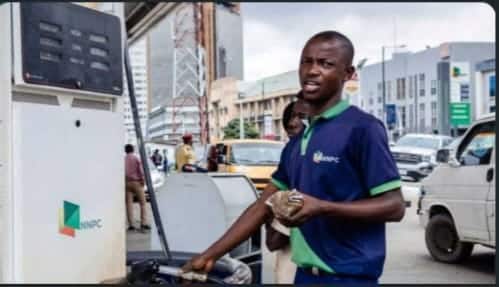
The Federal Government plans to offer a discount on petrol dispensed by NNPC Limited for an initial period of 30 days.
Public transport operators will receive priority under the arrangement, meaning the intervention is particularly targeted at reducing the fuel burden on commercial transport operators and, ultimately, transportation costs.
Oyedele stressed that the arrangement is not a return to the old petrol subsidy regime.
He said the government would instead be selling the product at cost under the temporary arrangement.
- The government is negotiating a ₦1,350 ceiling on petrol’s landing cost
The government is negotiating a ceiling of ₦1,350 per litre on the ex-gantry or landing cost of petrol.
This is perhaps the most important point to understand: ₦1,350 is not the proposed pump price at filling stations.
Rather, the ceiling is intended to reduce the effect of sudden increases in international crude prices and exchange-rate movements on domestic petrol costs.
The government wants to prevent petrol prices from immediately following every major movement in the international market.
- The ₦1,350 ceiling will be reviewed monthly
The proposed ceiling is not intended to remain permanently fixed.
According to Oyedele, the figure will be reviewed monthly, with the relevant information published for transparency.
Under the proposed arrangement, refiners and fuel importers would initially absorb additional costs when market prices rise above the agreed ceiling and recover the difference when market conditions subsequently improve.
The objective is to smooth out petrol-price fluctuations rather than impose a permanent fixed pump price.
- The government wants to reduce fuel-price volatility
The Federal Government says its immediate concern is not simply to establish one permanently fixed petrol price, but to make fuel prices more predictable.
Oyedele argued that price stability could provide greater certainty for households, transport operators and businesses.
His explanation was that a relatively stable price is preferable to sharp movements in which petrol prices rise rapidly but do not fall at the same speed when market conditions improve.
The proposed mechanism is therefore designed to cushion Nigerians against sudden price shocks.
- Local refiners could get more predictable crude supplies
The government is also exploring forward sales of crude oil to domestic refineries as local crude production increases.
The intention is to provide local refiners with greater certainty over their crude supply and reduce their exposure to sudden movements in international oil prices.
If implemented effectively, the government believes the arrangement could help local refiners plan production better and contribute to greater stability in domestic petrol prices.
- FG is targeting lower transportation costs
The petrol intervention is only one component of the broader plan.
The government says it will work with state authorities to remove illegal levies and road-use charges that add to the cost of moving passengers and goods.
It also plans to accelerate the deployment of Compressed Natural Gas (CNG) for transport operators.
The expectation is that lower fuel and operating costs will translate into lower fares for commuters.
The government is also considering sanctions against transport operators who exploit consumers, with proceeds from enforcement expected to support transport interventions.
Additional measures under consideration include increased cash transfers for vulnerable households and more direct credit support for small businesses.
This builds on the Federal Government’s existing National Affordable CNG Transit Programme. President Bola Tinubu had directed states to pursue measurable reductions in transportation costs from October 1, with CNG and electric vehicles forming a major part of the strategy.
- FG is considering fuel reserves, vouchers and other relief measures
The government is also considering several additional measures aimed at protecting households from further increases in the cost of living.
These include:
A possible excess-profits tax;
Targeted vouchers for low-income Nigerians;
Measures to reduce regulatory costs and other expenses affecting businesses;
The establishment of a national strategic fuel reserve;
Measures to protect fuel supplies from disruptions and hoarding;
Improved traffic management and logistics to reduce fuel consumption; and
Greater use of NIPOST address codes to help reduce logistics costs.
What Nigerians should understand
The Federal Government’s announcement represents a combination of immediate, temporary relief measures and longer-term attempts to stabilise energy and transportation costs.
The most immediate intervention is the proposed 30-day petrol discount at NNPC outlets, with priority for public transporters.
The proposed ₦1,350 figure should not be interpreted as a new nationwide pump price. It is a ceiling being negotiated for the ex-gantry or landing cost of petrol and is subject to monthly review.
At the same time, the government is seeking to reduce Nigerians’ dependence on petrol for transportation through CNG and electric mobility.
There is already evidence of lower fares on some government-supported routes. The State House says, for example, that CNG and alternative-energy transport services have reduced fares on selected routes in states including Borno, Oyo, Adamawa, Enugu, Plateau and Kaduna.
The key issue now is implementation — whether the measures will translate into sustained and measurable reductions in what Nigerians actually pay for petrol, transportation, food and other essential goods.




Leave a Reply