
By Opeyemi Adelakun
The 2027 presidential race is increasingly taking shape around competing proposals on how to address Nigeria’s economic difficulties, insecurity, energy challenges and rising cost of living.
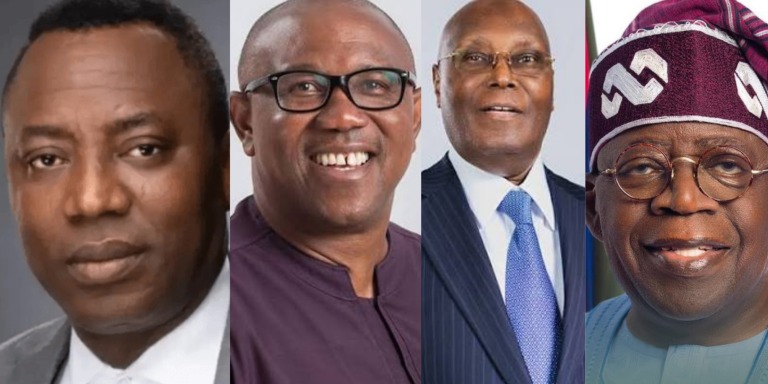
President Bola Tinubu and opposition candidates including Atiku Abubakar, Peter Obi, Adewole Adebayo, Omoyele Sowore, Seyi Makinde and Donald Duke have all outlined policy priorities ahead of the election.
Although their approaches differ, fuel pricing, electricity, employment, education, security and economic productivity have emerged as recurring themes.
Tinubu: Continue Economic Reforms
President Bola Tinubu is campaigning on the record of reforms introduced since he assumed office in 2023.
The APC candidate has defended the removal of petrol subsidy and the changes to the foreign exchange regime, arguing that the measures were necessary to address structural weaknesses in the economy.
Tinubu has promised to consolidate the reforms while focusing on industrialisation, energy security, infrastructure, food production and economic expansion.
His administration has also highlighted investments in education, electricity, domestic refining and infrastructure as part of its economic programme.
Atiku: Restore Targeted Subsidy
Atiku Abubakar has made petrol pricing one of the major distinctions between his campaign and Tinubu’s economic policy.
The ADC candidate says he would restore a targeted form of subsidy if elected, arguing that the removal of subsidy has increased the burden on households.
Atiku has since clarified that his proposal would focus on supporting petroleum products refined locally rather than recreating the previous import-based subsidy arrangement.
He has also proposed a production subsidy for locally refined petroleum products as part of a broader plan to reduce energy and transportation costs.
Obi: Shift From Consumption To Production
Peter Obi has centred his campaign on production, investment, enterprise and human capital.
The NDC candidate has called for greater investment in agriculture, manufacturing, education, infrastructure and security.
He has also pledged to increase electricity generation and distribution capacity by at least 10,000MW within four years if elected.
Obi has proposed greater transparency in the oil sector, including mechanisms to monitor crude production, transactions and revenues.
Adebayo: Jobs, Energy And Security
Adewole Adebayo’s campaign has focused heavily on employment, security, energy and social services.
The SDP candidate has pledged to tackle insecurity within four years and has proposed an ambitious expansion of electricity generation.
He has also proposed four functional refineries and a N200-per-litre target for petrol, cooking gas and Jet A1.
Adebayo says increased domestic refining and revenue from other petroleum products would help support the proposed pricing structure.
His agenda also includes free education and healthcare, agricultural development and measures aimed at reducing transportation and housing costs.
Sowore: AI, Blockchain And Social Services
Omoyele Sowore has presented a technology-driven policy agenda.
The AAC candidate has proposed the use of artificial intelligence to monitor public finances and detect possible fraud, while blockchain technology would be used to create transparent records of government transactions.
Sowore has also proposed drones and intelligence technology for national defence, alongside free education, expanded electricity supply and one million public mixed-income homes.
His campaign has further proposed a N500,000 monthly living minimum wage and measures aimed at industrialising the economy.
Makinde: Cheaper Domestic Crude For Refineries
Seyi Makinde has rejected a return to the former fuel subsidy model.
The APM candidate instead proposes preferential pricing for crude supplied to Nigerian refineries, arguing that locally produced crude should not be priced in the same way as crude sold internationally.
He has also called for transparency across the petroleum value chain, from crude allocation to refining, distribution and retail.
His broader policy agenda covers agriculture, education, security, petroleum and food production.
Duke: Productivity And Citizens’ Welfare
Donald Duke has placed productivity and the welfare of ordinary Nigerians at the centre of his campaign.
The PRP candidate has called for improved security for farmers and better learning environments for children.
Duke has also questioned the former fuel subsidy framework and argued that government should focus on creating conditions that allow citizens and businesses to become more productive.
“For me, the overall essence of government is productivity of its people,” he said.
The Major Policy Divide
The candidates are offering different approaches to the same economic pressures.
Fuel: Tinubu supports continuation of the post-2023 reform framework; Atiku proposes a targeted, production-linked subsidy; Obi has emphasised transparency and domestic production; Adebayo proposes a N200-per-litre framework; Makinde advocates cheaper crude for domestic refineries; while Duke questions the former subsidy model.
Electricity: Obi has proposed adding at least 10,000MW of generation and distribution capacity within four years, while other candidates have announced broader or more ambitious power-sector targets.
Economy: Tinubu is campaigning on continuity and consolidation of reforms, Atiku on reducing household costs through targeted intervention, Obi on production and investment, Adebayo on employment and decentralised production, and Sowore on technology-driven governance.
Security: The candidates have variously proposed stronger security institutions, improved intelligence, technology, policing reforms and greater protection for farmers and communities.
Social services: Education, healthcare, housing and employment also feature prominently across the competing platforms.

Leave a Reply