
By Charles Maduka
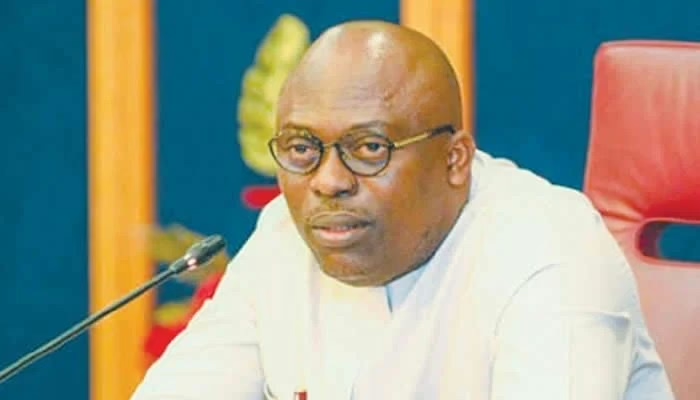
The All Progressives Congress has given reasons why Rivers State Governor, Siminalayi Fubara, has not been officially welcomed into the party following his recent defection.
Speaking during an interview on TVC, the APC National Chairman, Professor Nentawe Yilwatda, said the delay was a calculated political strategy aimed at managing regional and religious sensitivities, particularly in the northern part of the country.
Yilwatda explained that the party had prioritised activities in the north ahead of formal receptions in the south due to the approaching Ramadan period, noting that many northern communities are largely Muslim and sensitive to engagements during the fasting season.
He said the party decided to complete arrangements involving northern governors first before shifting attention to the south, stressing that the sequence was purely strategic and respectful of local circumstances.
The APC chairman dismissed suggestions that the delay had anything to do with Fubara’s authority or standing within the party, insisting that the governor’s leadership was not in question.
Reacting to claims that Fubara appeared unable to assert himself as the party’s leader in Rivers State, Yilwatda challenged anyone making such assertions to provide evidence of complaints or petitions against the governor.
He criticised what he described as media speculation, warning that the press should not invent disputes where none exist, adding that no formal complaint had been received by the party leadership.
Addressing remarks attributed to the Minister of the Federal Capital Territory, Nyesom Wike, on political actors in Rivers State aligning under President Bola Tinubu’s Renewed Hope agenda, Yilwatda clarified that support groups operate independently of the APC’s official party structures.
He emphasised that such groups are not under the authority of the party chairman and should not be confused with formal party activities.
The controversy surrounding Fubara’s position within the APC is rooted in a prolonged political crisis in Rivers State, which followed the breakdown of his relationship with his predecessor, Wike, after their 2023 political power struggle.
That crisis, at its peak, led President Bola Tinubu to declare a six-month state of emergency in the state in an attempt to restore stability.
Fubara officially defected from the Peoples Democratic Party to the APC in December 2025, a move widely interpreted as part of his strategy to seek re-election in 2027 and consolidate political support following his fallout with Wike.
However, Wike, who remains a major political force in Rivers State despite not being a member of the APC, has openly questioned the assumption that Fubara’s defection automatically makes him the party leader in the state.
He has argued that leadership is determined by control of grassroots structures, many of which are still occupied by his loyalists.
This situation has deepened political tensions in the state, with rival factions within both the APC and PDP engaging in impeachment threats, negotiations and power plays as political actors position themselves ahead of the 2027 general elections.

Leave a Reply