
By Opeyemi Adelakun
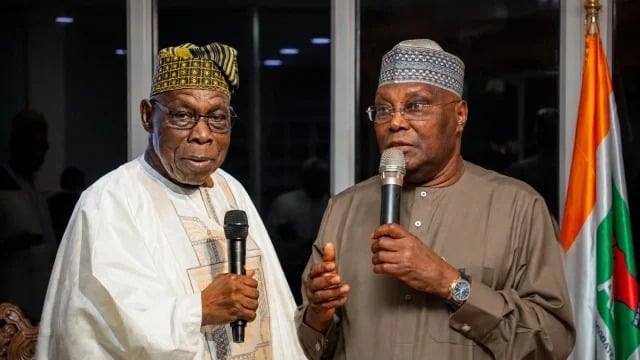
For more than two decades, the political relationship between former President Olusegun Obasanjo and his former deputy, Atiku Abubakar, has refused to settle into the quiet permanence of history.
Instead, old accusations have continued to resurface, each revival reopening questions about power, loyalty, succession and the bitter collapse of one of Nigeria’s most consequential political partnerships.
The latest dispute centres on an allegation by Obasanjo that Atiku mobilised the late Speaker of the House of Representatives, Ghali Na’Abba, to plot his removal during their time in office between 1999 and 2007.
Atiku, through his Media Adviser, Paul Ibe, has rejected the claim, accusing the former president of sustaining what he described as a more than 20-year campaign of “lies, political manipulation and orchestrated deceit” against him.
The latest response has therefore done more than challenge one allegation. It has reopened the political fault lines that defined the relationship between the two men, from the early days of the Fourth Republic to the disputes over succession, the controversial third-term bid, the Petroleum Technology Development Fund controversy and their eventual separation.
Ibe said Obasanjo’s latest allegation was another attempt to revive a narrative that, in Atiku’s view, could not withstand scrutiny.
“This time, he chose to make a man who passed away nearly three years ago the subject of his baseless allegation,” Ibe said, referring to Na’Abba, who died in 2023.
For Atiku’s camp, the timing and substance of the allegation are significant. Ibe argued that Obasanjo had repeatedly revisited allegations against the former vice president as political contests approached.
He described the latest claim as part of a pattern of what he called “lies, political manipulation and orchestrated deceit.”
But beyond the accusations and counter-accusations lies a more complicated history — one in which the men were once political allies, occupied the two highest elective offices in the country and secured a second term together before their partnership descended into one of Nigeria’s most enduring political feuds.
The Na’Abba Question
The immediate trigger for the latest confrontation is Obasanjo’s claim that Atiku used Na’Abba in an attempt to remove him from office.
Atiku’s camp disputes that version of events.
Ibe cited former House of Representatives member Abubakar Bwari, who served as Chief Whip during the 1999–2007 sessions, as contradicting the former president’s account.
According to Bwari’s account, as presented by Ibe, Na’Abba did not seek Obasanjo’s removal. Rather, Atiku was said to have acted as an emissary to lawmakers on behalf of the former president.
The distinction is important because the National Assembly was a major theatre of political tension during the period, with disagreements over executive-legislative relations frequently spilling into the public domain.
For Atiku’s camp, the Bwari account undermines the suggestion that the former vice president orchestrated a legislative plot against his principal.
Yet the controversy is unlikely to disappear merely because the principal actors are no longer available to settle it.
Na’Abba’s death has become part of Atiku’s argument against the allegation.
“He chose to make a man who passed away nearly three years ago the subject of his baseless allegation,” Ibe said, describing the claim as malicious.
The Loyalty That Became A Political Weapon
If the Na’Abba controversy represents one side of the old dispute, the 2003 re-election battle reveals another.
Atiku’s camp has now revived an account attributed to former Abia State governor Orji Uzor Kalu, who was also a PDP governor during the period.
Ibe cited a video in which Kalu reportedly described Atiku as the man who went before PDP governors to secure support for Obasanjo’s second-term bid.
“Atiku knelt down; we were like 17 governors. He knelt down for us and said that he does not want to be disloyal to Obasanjo. That four years is like four days,” Kalu was quoted as saying.
The account presents Atiku not as a politician attempting to displace Obasanjo, but as a loyal deputy protecting the political standing of his principal.
Ibe went further, quoting Kalu as saying that some governors had been positioning themselves for an arrangement that could have paved the way for Atiku to become president.
But, according to the account, Atiku refused to betray Obasanjo.
“Atiku was almost a President. We had gotten everyone to postpone the (PDP) convention and had gotten what we needed to move forward, but he (Atiku) said this man (Obasanjo) trusted him, and allowed him to work with him. That he cannot betray Obasanjo,” Kalu was quoted as saying.
That version of events sits at the heart of Atiku’s current defence: that his relationship with Obasanjo did not begin with betrayal, but with political loyalty that later became a casualty of the struggle over succession and power.
When Alliance Turned Into Rivalry
The story of Obasanjo and Atiku began differently.
Ahead of the 1999 presidential election, Obasanjo emerged as the PDP presidential candidate and selected Atiku as his running mate.
Their ticket won, ushering in the Fourth Republic after years of military rule.
They won a second term in 2003.
But beneath the appearance of political unity, tensions were gathering.
The question of what would happen after Obasanjo’s second term gradually became central to the relationship.
Then came the controversial third-term debate.
Obasanjo’s reported interest in extending his stay in office triggered fierce political opposition and deepened divisions within the ruling PDP.
Atiku emerged as one of the political figures opposed to the project.
The disagreement transformed the relationship between president and vice president from one of cooperation into open political confrontation.
The accusations that followed — including allegations of corruption and political betrayal — became part of the public record of the administration.
The PTDF Battle
Among the most contentious episodes was the Petroleum Technology Development Fund controversy.
Obasanjo asked the Senate to investigate alleged financial impropriety involving the fund shortly before the 2007 presidential election.
Atiku denied wrongdoing and submitted himself for investigation, maintaining that the funds involved remained in fixed deposit accounts.
He also argued that the allegations were politically motivated and connected to his opposition to Obasanjo’s third-term ambition.
Nearly two decades later, the controversy has again been dragged into the latest exchange.
Ibe relied on the autobiography of the late Awujale of Ijebuland, Oba Sikiru Adetona, Awujale, to challenge aspects of the narrative surrounding the PTDF affair.
The statement drew particular attention to the late monarch’s account of the treatment of Globacom Chairman, Mike Adenuga, by the Economic and Financial Crimes Commission during the period.
According to the account cited by Ibe, EFCC officials went to Adenuga’s Lagos residence on July 9, 2006, broke through the gate and detained him before he was later released after questioning.
“The EFCC purportedly were on the trail of some money belonging to the Petroleum Technology Development Fund, but there was really more beneath the veneer,” the statement quoted Adetona as writing.
Ibe alleged that the investigation was intended, among other things, to establish a connection between Adenuga and Atiku over the PTDF funds.
The Atiku camp also rejected the allegation that Adenuga used PTDF money to obtain Globacom’s operating licence, saying the businessman secured financing from BNP Paribas Bank for the transaction.
The Adenuga Dimension
The account becomes more politically complicated in the section dealing with Adenuga’s relationship with Obasanjo.
Ibe cited Adetona’s account that, after Adenuga’s detention and subsequent departure from Nigeria, the businessman later met Obasanjo.
According to the account, Obasanjo invited Adenuga to Ota and allegedly sought his assistance with the construction of an administrative block at Bells University, founded by the former president.
“Mike agreed, and Cachez Turnkey Projects Ltd handled the project for him,” the statement quoted Adetona as writing.
Ibe said Adenuga eventually left Nigeria amid what he described as continued harassment by the EFCC and returned after Obasanjo left office.
The Atiku camp argued that the account raised questions about the apparent contrast between Adenuga’s public treatment during the period and his alleged private dealings with Obasanjo.
These claims, however, form part of Atiku’s political camp’s response and should be understood as such. They do not, by themselves, establish wrongdoing by Obasanjo.
A Feud That Outlived Their Government
The collapse of the Obasanjo-Atiku relationship did not end when their administration left office.
Atiku left the PDP and contested the 2007 presidential election on the platform of the Action Congress after the bitter breakdown between the two men.
Since then, both have remained influential figures in Nigerian politics, occasionally finding themselves on the same side of major political questions but repeatedly returning to the unresolved disputes of their past.
Now, with another presidential election approaching in 2027, the old political history has once again become relevant.
Atiku is currently the presidential candidate of the African Democratic Congress, while Obasanjo remains one of the country’s most influential former leaders and political voices.
That context gives the latest exchange an importance beyond the personalities involved.
It is a reminder that in Nigerian politics, old alliances rarely disappear completely. They often survive as competing versions of history — each side preserving its own account of who betrayed whom, who sought power and who remained loyal.
For Atiku, the latest allegation is another chapter in what his camp considers a long campaign to undermine his political reputation.
For Obasanjo, the disputed account adds another layer to a relationship that has been defined by political cooperation as much as by rivalry.
For more than 20 years, the two men have offered Nigerians competing interpretations of the same political era.
And as the 2027 contest draws closer, the battle over that history may prove just as politically significant as the events themselves.
Obasanjo has yet to publicly respond to the latest allegations contained in Atiku’s statement.

Leave a Reply