
By Sunday Ameh
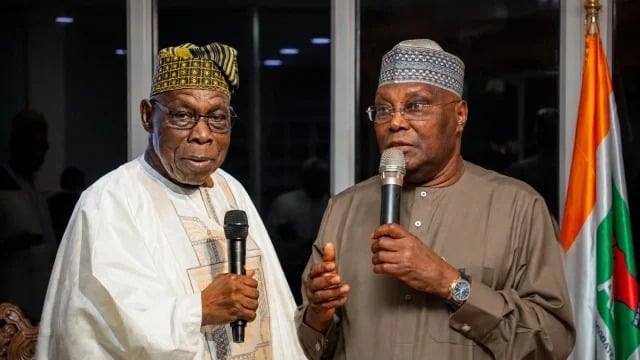
The lingering rift between former President Olusegun Obasanjo and former Vice President Atiku Abubakar is driven by political differences rather than personal grievances, Atiku’s Senior Political Assistant, Demola Olarewaju, has said.
Olarewaju made the claim on Monday during an interview on Frontline, a current affairs programme on Eagle 102.5 FM, Ilese-Ijebu, Ogun State, where he appeared alongside the Executive Director of the Centre for Responsive Governance, Ayodeji Ologun.
The latest exchange has revived the long-running disagreement between the two former leaders, whose relationship deteriorated after serving together from 1999 to 2007.
The feud recently took a fresh turn after Obasanjo described his decision to pick Atiku as his running mate in 1999 as the “biggest mistake” of his political life.
The former president also alleged that Atiku was involved in an attempt to impeach him in 2003, claiming that the former vice president paid ₦5 million to the late Speaker of the House of Representatives, Ghali Umar Na’Abba, to commence the process.
Atiku’s camp has rejected the allegation, describing Obasanjo’s account as part of what it called a pattern of “lies, deceit and historical distortion.”
Speaking during the interview, Olarewaju argued that Atiku does not harbour personal animosity towards Obasanjo, insisting that the former vice president continues to hold the former president in high regard.
According to him, the major disagreement between the two politicians is political.
“The relationship between the former President Obasanjo and Atiku, in my view as a Nigerian who witnessed the administration and the post-administration, is the fact that they do not seem to have a personal issue.”
Olarewaju, however, alleged that Obasanjo’s opposition to Atiku’s presidential ambition was the major source of the disagreement.
“The issue between them is political and, for reasons best known to Obasanjo, it is very clear and obvious that he does not want Atiku Abubakar to ever be President of the Federal Republic.”
He also questioned what he described as Obasanjo’s belief that no other Nigerian leader could surpass his achievements.
Olarewaju further described Obasanjo’s political activities after leaving office in 2007 as part of what he termed a “journey of redemption”, particularly concerning his relationship with the Yoruba people.
He also criticised what he described as differences in Obasanjo’s treatment of successive administrations, arguing that the former president had been more critical of the governments of Goodluck Jonathan and Muhammadu Buhari than of President Bola Tinubu.
Olarewaju maintained that Obasanjo’s opposition would not derail Atiku’s political ambition ahead of the 2027 presidential election.
“We are determined that this opposition won’t affect Atiku’s campaign,” he said.
Addressing concerns about Atiku’s age, Olarewaju argued that the focus should instead be on the structural problems affecting Nigeria.
He said excessive concentration of power at the federal level remained one of the country’s major challenges.
“One of the biggest problems that we have in Nigeria is that the Federal Republic of Nigeria is not actually federal.”
He argued that simply replacing one president with another without reforming Nigeria’s governance structure would not solve the country’s problems.
Supporting Olarewaju’s position, Ologun said Obasanjo’s current stance towards Atiku was inconsistent with his previous comments about the former vice president.
Ologun recalled that Obasanjo spoke positively about Atiku during the build-up to the 2019 presidential election, particularly regarding Atiku’s understanding of governance.
He said the former president’s earlier assessment of Atiku contrasted sharply with his present opposition to the former vice president.
“In 2019, Obasanjo spoke well about Atiku, saying that he knows well about running the affairs of the country.”
Ologun insisted that Atiku had not wronged Obasanjo in the manner being portrayed.
“But no matter what happens, we want Nigerians to understand the truth that Atiku never did a thing to Obasanjo.”
He added:
“Obasanjo is attacking Atiku for political reasons; he doesn’t want him to become the president.”
Ologun also dismissed concerns about Atiku’s age, describing the former vice president as one of Nigeria’s most experienced politicians.
The latest exchange has once again brought the Obasanjo-Atiku relationship into the spotlight.
Once regarded as a powerful political partnership that helped usher in Nigeria’s Fourth Republic in 1999, the relationship later deteriorated into bitter political rivalry.
Years after leaving office, both men have continued to disagree over their political legacies, the events surrounding their time in government and Atiku’s presidential ambitions.
With Atiku still active in opposition politics ahead of the 2027 presidential election, the latest comments suggest that the decades-old feud may remain a major talking point in Nigeria’s political space.



Leave a Reply