

By Paul Joseph
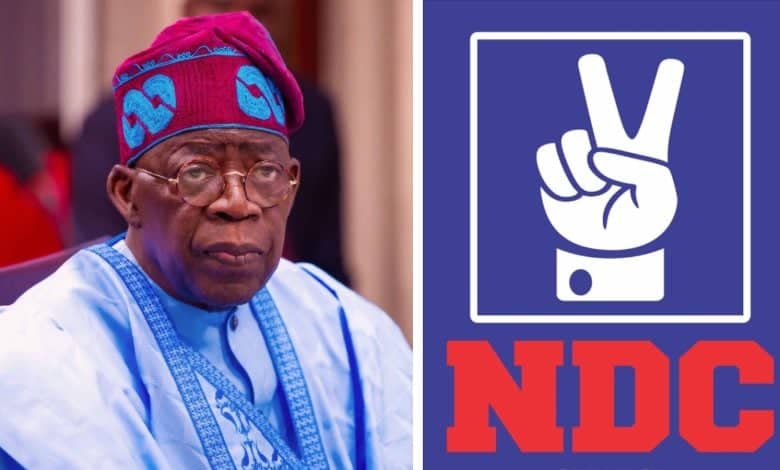
The Nigeria Democratic Congress (NDC) has criticised President Bola Ahmed Tinubu’s request for a fresh $7.7 billion (approximately ₦10.79 trillion) external loan, accusing his administration of excessive borrowing and calling for greater accountability in the management of public finances.
The party described the latest borrowing proposal as another episode in what it called the President’s recurring “one-week, new loan” pattern, warning that the country’s growing debt obligations could place additional financial burdens on future generations.
In a statement issued on Thursday, the spokesperson of the NDC National Presidential Campaign Council, Dr Chiogo Constance Ikokwu, urged Nigerians to participate actively in the January 16, 2027 general election and use their votes to demand transparency, fiscal responsibility and accountability from political leaders.
Ikokwu expressed concern over the increasing debt burden, arguing that the country’s economic future should not be compromised by what the party described as unsustainable borrowing and poor management of public resources.
She also questioned the level of legislative scrutiny given to the Federal Government’s borrowing requests, accusing the National Assembly of failing to independently examine the proposals before endorsing them.
“Truly, it seems that right now, we cannot stop President Tinubu from his One Week! New Loan! One Week! New loan! Borrowing spree, which is already hitting the roof, because, regrettably, he has pocketed the National Assembly. We seem to have a rubber-stamp legislature that before a loan request formally gets to its desk, it has already been endorsed,” she said.
The NDC spokesperson urged Nigerians to draw lessons from the November 4, 2026 American elections, which she said demonstrated the importance of citizens’ participation in determining political leadership.
According to her, Americans facing high living costs and economic difficulties had shown that the ballot remained an effective instrument through which citizens could influence governance.
She called on Nigerians to support the party’s presidential candidate, Peter Obi, and his running mate, Rabiu Musa Kwankwaso, in the forthcoming election.
Ikokwu, however, urged citizens not to lose hope in the country’s democratic process, insisting that electoral participation remained a critical avenue for demanding changes in governance.
“But Nigerians should not despair. The ballot remains our most powerful instrument of change. We appeal to citizens to use their votes to rescue the country from this debt trap and entrust its future to a government committed to transparency, accountability and prudent management of public resources,” she added.
Meanwhile, President Tinubu’s latest request for approval to secure the $7.7 billion external loan has been referred to the Senate Committee on Local and Foreign Debts for further legislative consideration.
The request was conveyed in a letter dated October 26, 2026, which Senate President Godswill Akpabio read during Wednesday’s plenary.
In the communication, Tinubu sought approval to raise ₦10,790,366,835,481, equivalent to $7,707,404,882.49, using the 2026 budget exchange rate of ₦1,400 to the dollar.
The President explained that the proposed external borrowing forms part of the ₦29.2 trillion new borrowing provision in the 2026 Appropriation Act, comprising ₦18.4 trillion in domestic borrowing and ₦10.79 trillion in external financing.
He said the borrowing would help finance part of the Federal Government’s 2026 budget deficit, estimated at ₦31.4 trillion, while supporting projects and programmes across critical sectors.
The proposed funding options include concessional and commercial facilities from multilateral and bilateral institutions, International Monetary Fund facilities, bridge financing, loan syndications and direct borrowing from international financial institutions.
However, Tinubu indicated that the government would place greater emphasis on Eurobond issuance, citing its relatively faster processing time and capacity to raise substantial funds.
He noted that the final interest rates, repayment periods and other financing conditions would depend on prevailing market conditions when the transactions are concluded.
On the proposed utilisation of the funds, the President identified defence and security, transportation, agriculture, power, education and healthcare as priority sectors.
He also argued that the foreign currency proceeds would strengthen Nigeria’s external reserves, as the funds would be received by the Central Bank of Nigeria on behalf of the Federal Government, providing additional support for the naira.
The latest proposal follows an earlier external borrowing request of about $20.52 billion and €1.045 billion submitted to the National Assembly under the Federal Government’s 2026–2027 Supplementary External Borrowing Plan.
Akpabio indicated that the new proposal superseded the earlier request, explaining that the revised arrangement provided clearer details on the proposed financing sources.
The Senate has directed its Committee on Local and Foreign Debts to scrutinise the latest request and report back for further consideration.

Leave a Reply