
By George Omagbemi Sylvester
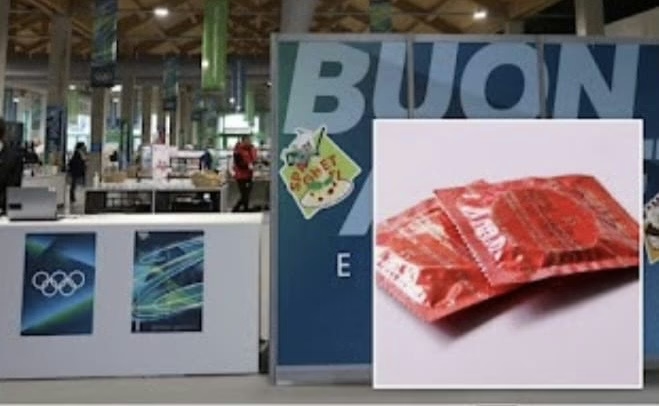
A minor but widely discussed logistical issue has emerged at the athletes’ village of the 2026 Winter Olympics in Italy, where organisers ran out of free condoms within just three days of distribution. This episode has drawn global attention to planning assumptions, athlete culture, and long-standing public health practices at the Olympic Games.
The shortage occurred at the athletes’ accommodation hubs for the Milano-Cortina Winter Olympics, which officially opened in early February 2026. According to multiple international reports, approximately 10,000 condoms were initially provided to around 2,800–3,000 athletes across the Olympic villages. By the third day of competition, the supply had been exhausted.
Officials from the local organising committee confirmed the shortfall, stating that the supply had been “temporarily depleted due to higher-than-anticipated demand” and promised fresh deliveries across the villages before Valentine’s Day weekend.
International Olympic Committee spokesman Mark Adams acknowledged the situation, noting that high usage was unsurprising given the environment of the Games and the concentration of young athletes from around the world.
The incident transpired in the Olympic villages located in Milan and Cortina d’Ampezzo during the opening week of the 2026 Winter Games. The condom distribution programme is a routine feature of the Olympics, designed primarily as a public health measure to promote safe sex among athletes and staff.
However, this year’s Winter Games began with a comparatively small stock. While the Paris 2024 Summer Olympics distributed around 300,000 condoms to over 10,000 athletes, the Italian organisers provided only about 10,000 for a smaller field of roughly 3,000 competitors.
Despite the smaller athlete population, the initial supply proved insufficient. By the third day, dispensers across the villages were empty, forcing organisers to arrange emergency restocking.
Italian regional governor Attilio Fontana defended the programme, emphasising that condom distribution has been an Olympic tradition since the 1988 Seoul Games and is primarily aimed at raising awareness about sexually transmitted infections.
The issue gained wider attention after Spanish figure skater Olivia Smart posted a viral social media video showing the branded condoms available in the village, a moment that underscored both the novelty and scarcity of the supplies.
While the shortage generated headlines, experts say the underlying dynamics are neither new nor scandalous. The Olympic Village is a unique environment: thousands of elite athletes, most in their 20s and 30s, live together after years of intense, isolated training.
Sports sociologists have long described the village as a “compressed social universe” where emotional release follows the pressure of competition. The late British sociologist Eric Dunning, known for his work on sport and social behaviour, observed that major sporting events often create “temporary communities with their own norms and rituals,” including heightened social and sexual activity.
Public health experts, meanwhile, stress that condom distribution is less about indulgence than about prevention. According to the World Health Organisation’s long-standing sexual health guidelines, large gatherings of young, mobile populations present elevated risks of sexually transmitted infections, making preventive access to protection essential.
As one Olympic medical official told previous Games organisers, the goal is simple: “You cannot control human behaviour, but you can reduce the risk that it causes harm.”
By mid-February, the organising committee had confirmed that additional supplies were being delivered and would be distributed across all villages before the end of the weekend, with continuous replenishment planned through the closing ceremony.
Officials stressed that the shortage was logistical rather than moral or disciplinary, and no health incidents had been reported as a result.
In practical terms, the episode underscores a familiar reality: the Olympic Village is not only a site of competition but also a dense social ecosystem. For organisers, the incident serves as a reminder that even at a smaller Winter Games, demand for health-related resources can exceed conservative estimates.
With the restocking already underway, the matter is likely to remain a brief footnote in the larger narrative of the Games. Yet it also highlights a subtle truth about global sporting spectacles: alongside medals, records, and national pride, the human element (predictable, imperfect, and often humorous) remains an inescapable part of the Olympic story.






Leave a Reply