

By Opeyemi Adelakun
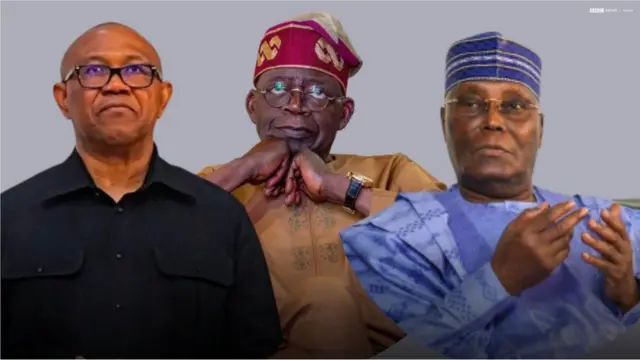
The 2027 presidential contest is increasingly taking the shape of a nationwide battle for political territory, with President Bola Tinubu, former Vice-President Atiku Abubakar and former Anambra State governor Peter Obi seeking to expand beyond the states their respective camps controlled in the 2023 election.
The three presidential candidates are now operating under different political platforms, with Tinubu flying the flag of the All Progressives Congress (APC), Atiku contesting under the African Democratic Congress (ADC) and Obi representing the Nigeria Democratic Congress (NDC).
Their campaigns are expected to focus heavily on states won by rival candidates in 2023, as the parties attempt to consolidate existing support while building new alliances ahead of the January 16, 2027 presidential election.
INEC’s final list confirms Tinubu, Atiku and Obi among the 18 presidential candidates cleared for the election.
In 2023, Tinubu won 12 states, Atiku won 12, while Obi won 11 states and the Federal Capital Territory.
The political landscape has since changed considerably, with several elected governors changing parties and new alliances emerging ahead of the next election.
APC targets more territory
Within the APC, party officials say the governing party has strengthened its structure since 2023 and intends to increase the number of states it wins.
The APC’s North-Central Forum chairman, Saleh Zazzaga, also identified Plateau, Benue and Nasarawa as states the party was targeting.
He said the party expected the movement of governors and political leaders into the APC to translate into stronger structures during the election.
Zazzaga specifically claimed that Tinubu would win Plateau, which the APC lost in 2023, while also targeting Benue and Nasarawa.
He further claimed that the president would win all six South-West states in 2027.
Those are party projections and do not constitute verified election outcomes.
Atiku camp banks on opposition realignment
The ADC is similarly seeking to broaden Atiku’s reach by capitalising on the movement of politicians and supporters from other parties into its fold.
Ralph Nwosu, immediate past national chairman of the ADC, claimed that the party had stronger structures than it possessed in 2023 and was positioned to secure a larger spread of votes.
Nwosu also cited an internal poll which he said projected Atiku to receive 63 per cent of votes nationwide and secure at least 25 per cent of votes in 28 states.
He did not provide independent evidence of the poll’s methodology or findings in the report.
Nwosu further claimed that significant numbers of members of the Peoples Democratic Party, Labour Party and APC had moved into the ADC.
He said the party expected the realignment to strengthen Atiku’s position across several states.
The claims come against the background of wider opposition discussions about whether the various parties and presidential contenders could work together ahead of the election. Earlier talks on a possible single opposition candidate involved several parties, although Atiku and Obi were not present at the initial summit.
Obi seeks to widen 2023 base
Obi’s NDC is also looking beyond the states where the former Anambra governor performed strongly in 2023.
Yinusa Tanko, National Coordinator of the Obidient Movement, said the party’s structures had expanded and that Obi was now working with a broader political network.
He specifically pointed to the presence of Rabiu Kwankwaso as Obi’s running mate as a factor he believes could expand the ticket’s reach in northern Nigeria.
“The dynamics have changed now, and we are working and expecting to win more states,” Tanko said.
He also cited the number and strength of NDC candidates contesting legislative and other positions as evidence of a wider organisational network.
Tanko said Obi’s camp was targeting Lagos again while seeking additional states in the North and other parts of the country.
However, those expectations remain campaign claims rather than established electoral results.
From 2023 map to 2027 realignment
The three campaigns are therefore entering the next phase of the election with significantly different political maps from those that existed in 2023.
Tinubu’s APC is seeking to consolidate the governing party’s expanded network and make gains in states controlled by opposition parties.
Atiku’s ADC is banking on opposition realignment and defections to broaden its reach, while Obi’s NDC is seeking to combine its existing support base with new political structures and its alliance with Kwankwaso.
The final presidential candidate list has now formally fixed the three tickets ahead of the January 16 poll, with Tinubu paired with Kashim Shettima, Atiku with Rotimi Amaechi and Obi with Kwankwaso.




Leave a Reply