
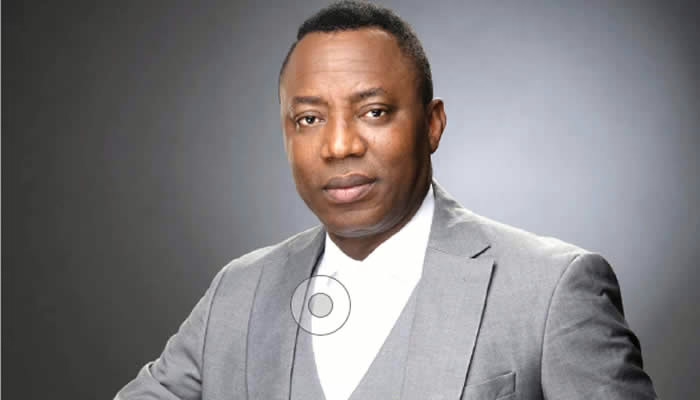
- Reveals How He Funds Court Cases and Plans to Transform Nigeria
Omoyele Sowore is a renowned activist, Publisher of Sahara Reporters, a former presidential candidate, and founder of the African Action Congress (AAC). In this interview, he speaks with Akinrinlola Olumide, publisher of Starnews NG. He gives reasons why he is not satisfied with past governments in Nigeria, from the administration of former President Olusegun Obasanjo to the current administration of President Bola Ahmed Tinubu. He also talks about his presidential ambition, numerous court cases, funding, and how he intends to transform Nigeria if elected president.
Activism Background: What initially drew you to activism, and how has that shaped your approach to politics today?
I was drawn into activism very early by lived injustice, growing up in Kiribo, now in Ese-Odo Local Government in Ondo State. As a child, I witnessed police oppression, an invasion by the kill-and-go police in my hometown, and as a student, I saw how power was abused and how silence enabled oppression. That experience shaped my politics into one grounded in resistance, accountability, and people power, not elite consensus or transactional politics.
Court Cases Funding: You have faced numerous legal battles throughout your career. How do you manage the financial burden of these court cases, and what does it say about the state of political dissent in Nigeria?
The financial burden of court cases is enormous, and it is deliberately designed to break dissenters. I survive through personal sacrifice, support from committed citizens, and solidarity networks, and a group of committed attorneys who offer the best legal pro bono support, wherever I am oppressed or persecuted across Nigeria, north or south. It says clearly that in Nigeria, dissent is criminalised, and the justice system is often weaponised to punish those who challenge tyranny, corruption, and intoxicated power.
Perception of Tinubu: Many perceive your stance toward Bola Tinubu as deeply critical. What, if anything, do you think Tinubu’s government has done well, and how do you reconcile that with your criticisms?
I have found very little to commend in Tinubu’s government. Governance is about outcomes for the people, not propaganda. My criticisms are rooted in facts, such as worsening poverty, insecurity, repression, and corruption. I reconcile this by speaking the truth consistently, regardless of who is in power.
Political Relationships: You have often been seen as an outsider to the political elite. How do you plan to navigate the complexities of Nigerian politics while maintaining your principles?
I have always been an outsider by choice. Nigerian politics is criminal because it is built on crime and betrayal. I navigate it by staying rooted in principles, mass movements, and transparency, rather than elite deals and the politics of convenience. Power should flow from the people upward, not from godfathers downward.
Ambition for Presidency: What motivated you to enter the presidential race, and what unique vision do you bring to the table that differentiates you from established politicians?
I entered the presidential race because Nigeria needs a complete break from recycled failures. My vision is radical accountability, people-centred governance, and dismantling systems of impunity. Unlike established politicians, I have never looted public funds, betrayed the people, or compromised with oppression. I am not an opportunist, and I believe in revolutionary outcomes. Nigerians have lost so much ground to these failed experiments and transactional politicians.
Satisfaction with Past Governments: You have expressed dissatisfaction with previous administrations from Obasanjo to Tinubu. Can you elaborate on what specific policies or actions have led you to this conclusion?
Let me start from 1999: from Olusegun Obasanjo to Bola Tinubu, successive governments have embraced neoliberal policies that deepen inequality and poverty, protect corruption, and resort to force rather than governance. Privatisation scams, electoral fraud, repression of protests, and tolerance of insecurity define these administrations, not progress.
Winning Elections: Given your history of opposition to various political figures, do you believe you can win a presidential election without the support of traditional political structures or alliances?
Yes, I believe it is possible to win without traditional structures. Those structures are the problem. Elections are won by people, not godfathers and compromised electoral officers. The challenge is not popularity but overcoming rigging, voter suppression, and state-sponsored violence.
Youth Engagement: How do you plan to engage and mobilise young voters who may feel disillusioned with the current political landscape?
Young people are already engaged; they are just disillusioned. My approach is honest politics, direct engagement, digital organising, issue-based campaigns, and the creation of platforms where youth are decision-makers, not foot soldiers acting against their own interests.
Vision for Governance: If elected, what are the first three key policies you would implement to address the pressing issues facing Nigeria today?
First, invest in the energy sector to help big and small businesses grow, dismantle corruption networks, and recover stolen assets. Second, invest massively in education, healthcare, and jobs. Third, reform the security architecture to protect citizens rather than terrorise them.
Legacy and Impact: What legacy do you hope to leave as a politician, and how do you want to be remembered by the Nigerian people in the future?
I don’t really bother with a fixation on legacy. I sometimes don’t worry about how I want to be remembered, but I’d love to inspire others to see me as someone who never bowed to tyranny, never stole from the public, and consistently stood with the oppressed. For me, legacy is not titles but impact.
Enforcing Local Government Autonomy: Given that virtually all state governors have not complied with the Supreme Court’s judgment on local government autonomy, what specific actions would you advise President Tinubu to take in order to enforce this ruling effectively?
President Tinubu is playing politics with direct federal allocations to democratically elected local governments; otherwise, by now, we should be prosecuting governors who violate the Supreme Court ruling and empowering the judiciary to enforce compliance without political interference.
Addressing Corruption: Corruption has been a persistent issue in Nigerian governance. If elected, what concrete steps would you take to tackle corruption at all levels of government?
Corruption must be tackled structurally. This includes transparent budgeting, open procurement systems, independent prosecution, asset recovery, ending security vote abuse, and protecting whistleblowers. Corruption survives because the system protects it; my goal is to dismantle that protection.
Leave a Reply