
By Paul Joseph
The education sector in Nigeria consistently encounters major challenges, which education experts primarily link to entrenched cultural, economic, and social issues, as well as a lack of security and insufficient financial resources that hinder educational advancement.
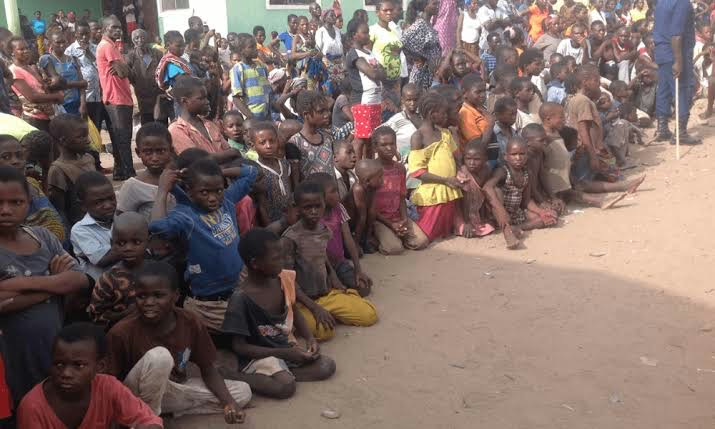
From this perspective, the United Nations Children’s Fund (UNICEF) has expressed concerns over the rising number of children in Northern Nigeria specifically who are not enrolled in school.
Girls, in particular, are facing significant challenges due to entrenched cultural, economic, and social barriers that hinder their educational advancement.
This concern was voiced by Mr. Rahama Rihood Mohammed Farah, the Chief of UNICEF’s Field Office in Kano, during a keynote speech at the 2026 International Day of Education (IDE) event held in Dutse, the capital of Jigawa State.
Farah pointed out that poverty, insecurity, harmful social norms, and limited educational resources are key factors undermining learning outcomes and diminishing the hopes of children in the region.
The event gathered stakeholders from UNICEF-supported states, including Kano, Katsina, and Jigawa, and was themed “The Power of Youth in Co-Creating Education.” UNICEF emphasized the importance of involving young people in discussions about the future of education leading up to 2030.
While acknowledging some progress in parts of Northern Nigeria, Farah encouraged young people to take the initiative in reforming the country’s education system, emphasizing that education is a fundamental right, a source of hope, and the cornerstone of sustainable national development.
Speaking to government officials, development partners, educators, parents, media representatives, and youth, Farah stated that education is the most powerful tool for breaking cycles of poverty and creating a future where every child can thrive with dignity.
“Education is not merely a service; it is a right, a beacon of hope, and the foundation of every strong society,” he asserted. “It empowers every child—whether girl or boy—to dream, contribute meaningfully to their communities, and walk with pride.”
He noted that young people are advocating for an education system that is relevant, inclusive, safe, and empowering—one that fosters creativity, encourages learning, and ensures no child is left behind.
“They desire classrooms that spark imagination, inspiring teachers, and systems that support every child,” Farah remarked. “Education must extend beyond textbooks to provide children with life skills, digital literacy, critical thinking, and the confidence to shape their own futures.”
He concluded that the International Day of Education should serve not only as a time for reflection but also as a call for renewed commitment and collective action.
At UNICEF, we are dedicated to assisting governments and communities in Kano Field Office states to enhance education systems, improve learning environments, promote adolescent development, and ensure access to education for all.



Leave a Reply