
By Paul Joseph
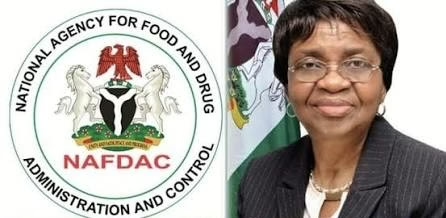
The Director-General of the National Agency for Food and Drug Administration and Control (NAFDAC), Prof. Mojisola Adeyeye, has declared that the agency has resumed enforcement of the ban on the production and sale of alcoholic beverages in sachets and small-volume PET or glass bottles (below 200ml).
The new move followed a recent directive by the Senate of the Federal Republic of Nigeria.
In a statement issued to journalists on Thursday, Adeyeye emphasised that the ban is not directed at alcohol manufacturing companies.
She explained that the Senate-ordered measure, backed by the Federal Ministry of Health and Social Welfare, underscores NAFDAC’s statutory duty to safeguard public health, particularly vulnerable groups such as children, adolescents, and young adults, from the destructive effects of alcohol.
The widespread circulation of high-alcohol-content beverages in sachets and small bottles has rendered them cheap, accessible, and concealable, fuelling misuse and addiction among minors and some commercial drivers.
This escalating public health crisis has been tied to domestic violence, road accidents, school dropouts, and other social vices.
Adeyeye stressed that merely labelling these products “not for children” is futile in Nigeria’s social context. Sachets are inexpensive and easily hidden, making parental monitoring almost impossible.
Reports from schools reveal disturbing trends: some pupils conceal sachets, and in one case, a student admitted he could not sit an exam without consuming sachet alcohol.
NAFDAC recalled the six-year moratorium granted to manufacturers to phase out sachets and small bottles. In December 2018, the agency, in collaboration with the Federal Ministry of Health and the Federal Competition and Consumer Protection Commission (FCCPC), signed a five-year Memorandum of Understanding (MoU) with the Association of Food, Beverage and Tobacco Employers (AFBTE) and the Distillers and Blenders Association of Nigeria (DIBAN) to eliminate small-volume packaging by 31 January 2024.
The deadline was later extended to December 2025 to enable the industry to exhaust old stock and reconfigure production lines.
The current Senate resolution is consistent with that agreement and Nigeria’s pledge to the World Health Assembly Global Strategy to Reduce the Harmful Use of Alcohol (WHA63.13, 2010).
The goal is to restrict alcohol access to children and youth. NAFDAC continues to approve alcohol in larger pack sizes, stressing that the ban applies solely to sachets and bottles under 200ml, and no alcohol company has been shut down.
Prof. Adeyeye’s statement partly reads, “This ban is not punitive; it is protective. It is aimed at safeguarding the health and future of our children and youth by not allowing alcohol in small pack sizes. The decision is rooted in scientific evidence and public health considerations. We cannot continue to sacrifice the wellbeing of Nigerians for economic gain. The health of a nation is its true wealth.”
NAFDAC reiterated that only two categories of alcoholic beverages are affected, spirit drinks packaged in sachets and small-volume PET/glass bottles below 200ml.
The Agency urged all stakeholders, including manufacturers, distributors, and retailers, to comply fully with the phase-out deadline, warning that no further extension will be granted beyond December 2025.
It pledged continued collaboration with the Federal Ministry of Health and Social Welfare, the Federal Competition and Consumer Protection Commission (FCCPC), and the National Orientation Agency (NOA) to drive nationwide sensitisation campaigns on the health and social dangers of alcohol misuse.
NAFDAC reaffirmed its unwavering commitment to ensuring that only safe, wholesome, and properly regulated products are available to Nigerians.
Prof. Adeyeye stated, “This ban is not meant to punish; it is intended to protect. Its goal is to ensure the health and future of our children and youth by prohibiting alcohol in small packaging. This decision is based on scientific research and public health concerns. We cannot prioritize economic benefits over the well-being of Nigerians. The true wealth of a nation lies in its health.”
NAFDAC clarified that the ban affects only two types of alcoholic beverages: spirit drinks sold in sachets and small PET or glass bottles under 200ml.
The Agency called on all stakeholders, including manufacturers, distributors, and retailers, to fully comply with the phase-out deadline, emphasizing that no extensions will be granted beyond December 2025.
It committed to ongoing collaboration with the Federal Ministry of Health and Social Welfare, the Federal Competition and Consumer Protection Commission (FCCPC), and the National Orientation Agency (NOA) to promote awareness campaigns about the health and social risks associated with alcohol misuse.
NAFDAC reaffirmed its dedication to ensuring that only safe, wholesome, and properly regulated products are available to the Nigerian public.






Leave a Reply