
By George Omagbemi Sylvester
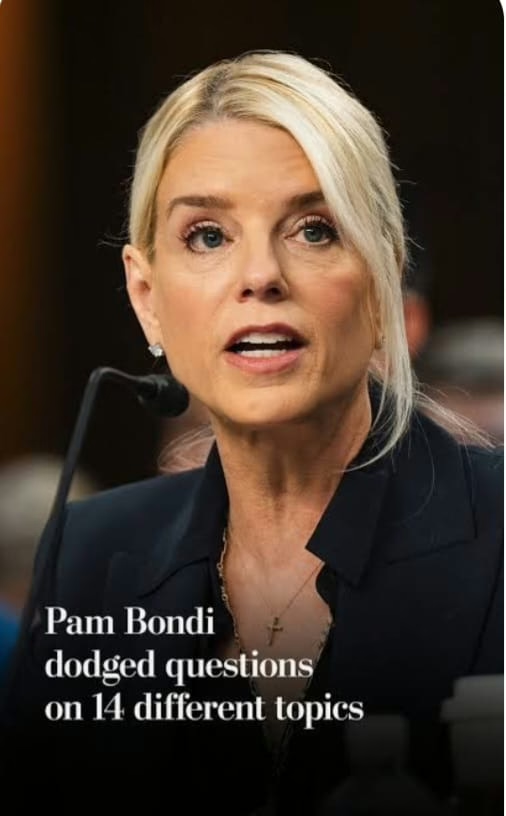
In an extraordinary confrontation that tests the limits of executive authority, constitutional safeguards and federal-state relations, a federal judge has openly questioned the legality and propriety of the Trump administration’s sweeping immigration enforcement operation in Minnesota and more specifically, the controversial demands made by U.S. Attorney General Pam Bondi. Those demands, seemingly offered as conditions for de-escalating federal action on the ground, have ignited legal, political and civic alarm across the United States and drawn scrutiny from constitutional scholars, civil rights experts and elected officials alike.
At the heart of the dispute lies an intervention by the Department of Homeland Security (DHS) known as Operation Metro Surge, a deployment of Immigration and Customs Enforcement (ICE), Border Patrol and other federal agents to Minnesota’s Twin Cities region, originally justified as a crackdown on undocumented immigration, violent crime and drug trafficking. As the operation has unfolded, it has become the subject of intense dispute over its methods, its legality and the extraordinary powers it claims to exercise.
A Legal Flashpoint: Bondi’s Demands and a Federal Judge’s Skepticism
Earlier this week, U.S. District Judge Katherine Menendez heard arguments over a request by Minnesota and local authorities to temporarily halt the federal enforcement operation. In the course of that hearing, Judge Menendez expressed deep skepticism about the scope of the federal government’s actions, including the extraordinary conditions articulated by Attorney General Bondi in a letter to Minnesota Democratic Governor Tim Walz.
In that letter, Bondi demanded that Minnesota surrender its voter rolls, Medicaid and food assistance records and repeal sanctuary policies (effectively obliging the state to hand over sensitive personal information of millions of residents, restructure key local policies and facilitate full federal cooperation) as part of a package of measures the federal government branded as essential to protecting public safety and “restoring the rule of law.”
“I am confident that these simple steps will help bring back law and order to Minnesota and improve the lives of Americans,” Bondi wrote, framing her demands as a necessary course correction in the face of what the administration called state inaction.
Judge Menendez, however, challenged the very premise of such demands. In open court, she asked pointedly whether there is any constitutional limit to executive action if it is claimed to be part of enforcing immigration law. “Is there no limit to what the executive can do under the guise of enforcing immigration law?” she asked, underscoring the alarming constitutional implications of subordinating civil liberties to broad executive discretion.
Her questioning touches a profound legal and philosophical fault line in American governance: when, if ever, can the federal government leverage coercive power to compel state compliance beyond established statutory authority?
A Surge Steeped in Violence and Controversy
The federal operation itself has already been marred by tragedy. The surge has been linked to multiple shootings by federal agents, including the death of Renée Good, a 37-year-old American citizen shot by an ICE agent and Alex Pretti, who was killed by a Border Patrol officer in Minneapolis, incidents that have shocked communities and heightened tensions on the ground.
These incidents sparked protests and intensified calls by local leaders (including Minnesota Governor Walz) for the withdrawal of federal forces. Governor Walz characterized the deployment as a violent occupation that threatens civil order and public safety rather than protecting it.
In their lawsuit, Minnesota, Minneapolis and St. Paul argue that the federal operation has not only failed to deliver on its stated objectives, but has created conditions of chaos and danger, eroding public trust and overwhelming local institutions tasked with maintaining public safety.
Democratic Institutions Under Strain
Minnesota Assistant Attorney General Brian Carter delivered one of the most forceful condemnations at the federal hearing, warning that unfettered executive action threatens the very foundation of democratic governance.
“If this is not stopped right here, right now, I don’t think anybody who is seriously looking at this problem can have much faith in how our republic is going to go in the future,” Carter told Judge Menendez, encapsulating a broader fear among constitutional scholars that unchecked use of federal power could erode federally guaranteed civil liberties and upend long-established norms of federalism.
Keith Ellison, Minnesota’s Attorney General, has likewise decried the enforcement surge as “an unprecedented abuse of federal power,” asserting that the federal government’s strategy amounts to an aggressive overreach that undermines the legitimate autonomy of state and local decision-making.
Legal, Ethical and Constitutional Questions
The federal government’s position, articulated by Department of Justice attorney Brantley Mayers, is that all actions remain within the bounds of enforcing federal immigration law and that additional pursuits (such as seeking welfare data or voter records) are lawful exercises of the Constitution’s powers.
Yet legal experts argue that the consolidation of disparate objectives under the broad umbrella of immigration enforcement raises serious constitutional issues, not least concerning privacy rights, data protection and the Fifth Amendment’s protection against government coercion.
Professor Samuel Bagenstos, a constitutional law scholar at a leading U.S. university, notes that the demand for voter rolls and welfare data in exchange for altering federal enforcement posture threatens to transform law enforcement into a mechanism of conditional leverage rather than impartial justice. In his words, “When law enforcement becomes negotiable with political ends attached, we step into a perilous realm where power supersedes principle.”
Such concerns are not abstract. Voter rolls and public assistance records contain sensitive personal information that states have historically protected from federal overreach, both to safeguard individual privacy and to preserve electoral integrity. Experts warn that compelling the disclosure of such data absent clear statutory authority risks violating both federal privacy laws and core constitutional liberties.
Politics, Power and the Future of Federalism
At the political level, Bondi’s letter and the federal response have ignited fierce debate. Critics across the political spectrum have condemned what they describe as a form of coercive bargaining that weaponizes federal enforcement power to extract concessions with unclear legal basis.
Minnesota Secretary of State Steve Simon rejected the demands outright, calling the request for voter data “an outrageous attempt to coerce Minnesota into giving the federal government private data on millions of U.S. citizens in violation of state and federal law.”
Meanwhile, state officials contend that sanctuary policies (which limit cooperation with federal immigration enforcement) are lawful exercises of local governance and vital to protecting immigrant communities from undue harm.
This clash highlights a long-standing tension in American federalism: the balance between national authority and state sovereignty. The federal government’s attempt to press Minnesota into compliance using conditional demands reflects a broader trend in U.S. politics toward centralization of power and a trend that critics argue erodes the constitutional system of checks and balances that defines American democracy.
A Constitutional Test Case
As the case proceeds, the judge’s cautious and probing approach signals the seriousness with which the federal judiciary is treating these questions. By demanding clear limits on executive actions cloaked in the language of law enforcement, the court throws into sharp relief the enduring principle that no branch of government (not even the executive) is above constitutional constraint.
The world watches as Minnesota becomes a test case for the very soul of American governance: whether a government that claims to uphold the rule of law can be held accountable to it when its own actions are in dispute.
The outcome will not only determine the fate of the current enforcement surge but will set precedent for future federal-state engagements with profound implications for immigration policy, civil liberties and the resilience of democratic institutions.
This is not merely a legal dispute; it is a battle over the soul of a nation striving to reconcile security with liberty, authority with accountability and power with principle.





Leave a Reply